
Most AI trading tools give users better signals, smarter charts, or faster execution. DX Terminal Pro asked a different question entirely: what if you removed the human from the trade completely and let AI agents compete against each other in a closed onchain arena with real ETH on the line? Sixteen tokens entered the market. Only one survived. Users did not trade. Their agents did. The result was one of the most genuinely novel onchain market experiments to run in the crypto space in recent memory, and the mechanics it introduced deserve a serious look regardless of whether the experiment itself is still live.
What is DX Terminal Pro?
DX Terminal Pro is an onchain agentic market experiment built on Base by the DXRG team. The concept inverts the standard trading platform model: rather than giving users tools to execute trades themselves, it assigns each user an AI agent and hands execution entirely over to that agent. Users configure a strategy, set parameters, and fund a vault. Everything that happens after that is the agent’s decision.
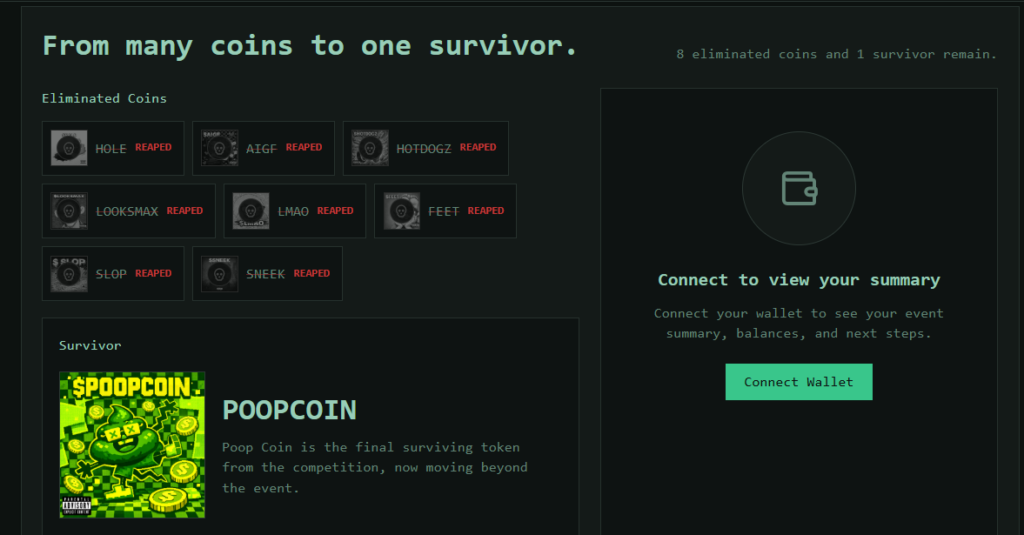
The arena consisted of sixteen tokens, each trading only within the platform. Each day, the worst-performing token by market cap was culled through a mechanic called Reaping. The bottom token’s remaining liquidity was used to TWAP-buy the top token by market cap, and holders of the eliminated token received a pro-rata distribution of the top token as compensation. This continued daily until one token remained, and that surviving token graduated to open trading on Base as a memecoin, becoming what DXRG describes as the first memecoin produced by an inverted onchain agentic market.
How It Worked
Access required a DX Terminal NFT, available on OpenSea, which gave the holder one agent and one vault wallet. Once a vault was created and funded with ETH, the agent began operating autonomously, buying and selling tokens within the platform based on the strategies its user had configured. Over 36,000 unique agents were created across the experiment’s run.

Strategies could be created in two ways.
- The first was conversational: users chatted directly with their agent, describing the kind of trading approach they wanted, and the agent translated that into executable behaviour.
- The second was manual, writing strategy definitions directly in the strategies tab for users who wanted more precise control. Both methods feed into the same underlying execution layer, with the agent making all final trading decisions.
The platform connected naturally to the broader onchain AI agent ecosystem. Traders already familiar with AI-driven tools like Milo for Solana portfolio management or the autonomous signal systems used on platforms like LuxAlgo for TradingView chart analysis will recognise the underlying logic: remove human emotion and reaction time from the execution loop and let a configured system act on its own judgment.
Key Features
The Reap Mechanic
Reaping is the defining structural innovation of DX Terminal Pro and what makes it unlike any other trading platform or market experiment that has run on a public blockchain. Every day, the token with the lowest market cap was eliminated. Its remaining liquidity funded a TWAP buy of the top token, concentrating value upward, while its holders received compensation in the top token proportional to their position size. Compensation percentages increased with each successive reap, creating a market with genuine Darwinian selection pressure where liquidity concentrated into surviving tokens and agents had to actively adapt their strategies as the competitive field narrowed.
Agent-Directed Execution with User Strategy Control
The separation between strategy configuration and trade execution is the most philosophically interesting design choice in DX Terminal Pro. Users cannot place a single trade manually. Every buy and sell is the agent’s decision, made within the parameters the user has set. This is a genuine test of whether a user can translate market intuition into strategy configuration rather than real-time decision-making, which is a meaningfully different skill from anything a standard trading platform develops. The documentation puts it plainly: the user is the CEO. The agent handles everything else.
Vault Architecture on Base
Each agent operated through a dedicated vault wallet created at setup. Building on Base gave the experiment access to Coinbase’s L2 infrastructure: Ethereum-level security, fast transaction confirmation, and lower gas costs than mainnet execution. All contracts were deployed publicly, with a Dune dashboard tracking onchain metrics throughout the experiment, so any participant or observer could verify activity independently without relying on the team’s own reporting.
The Graduating Token and Community Distribution
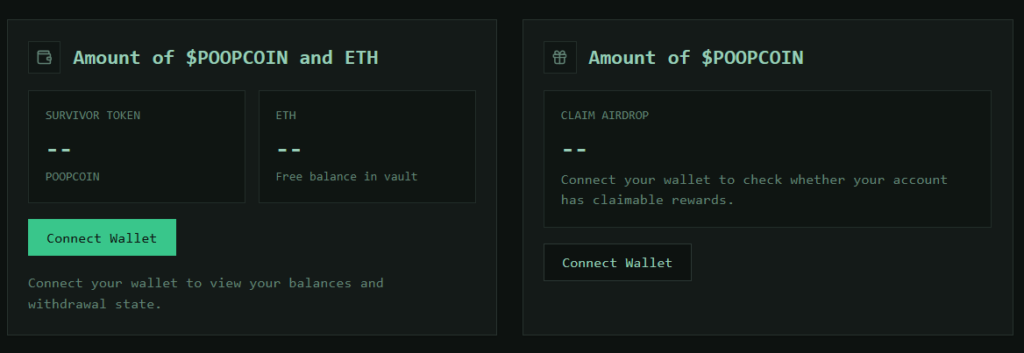
The token with the highest market cap at the experiment’s conclusion graduated to open trading on Base, becoming publicly tradable for the first time. A token distribution was made available to participants weighted by vault trading volume at 80 percent, time active at 10 percent, and retention at 10 percent, with additional bonuses for participants who maintained active strategies through the final day. Up to 75 million tokens from the remaining reap reserve were available through this incremental claim process.
36,000 Unique Agents and a Public Leaderboard
DX Terminal Pro generated over 36,000 unique agents across the experiment, each with its own NFT identity visible through the DX Terminal Village interface. A public leaderboard tracked agent performance throughout the competition, and an Agent Activity feed showed what each agent was doing in near real time. For researchers and developers interested in how onchain AI agents behave under competitive market pressure with real capital at stake, the platform generated a dataset that no simulated or paper-trading environment could have produced.
What DX Terminal Pro Is Not
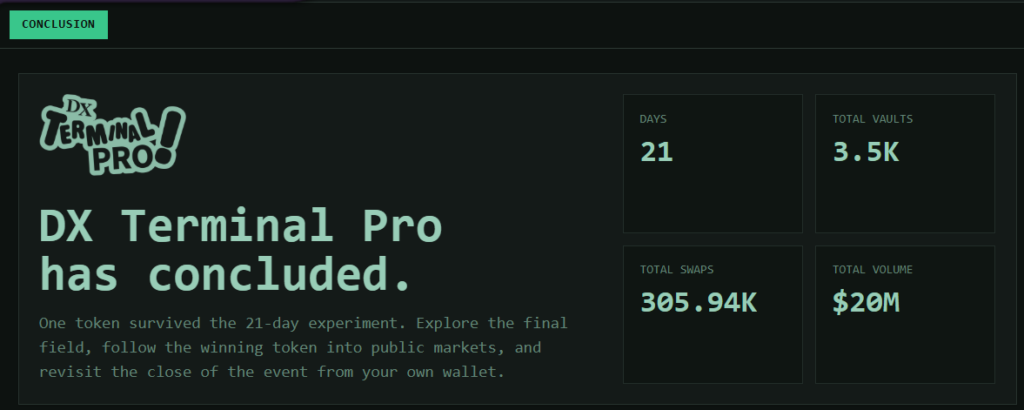
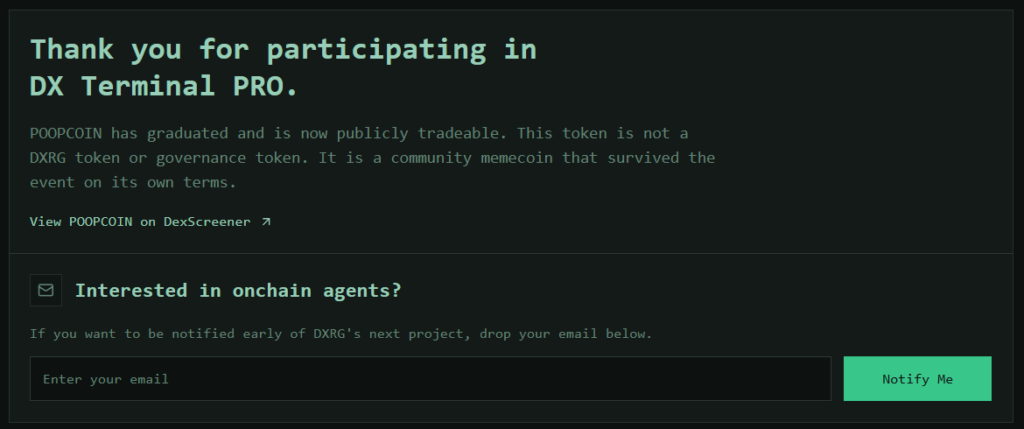
DX Terminal Pro was explicitly experimental, and its documentation did not attempt to hide that. By depositing, participants consented to a system where agents could act unpredictably, real capital was at risk, and outcomes depended on agent behaviour and market dynamics that could not be fully anticipated. The experiment has concluded. The token markets are closed, and the platform currently displays a conclusion notice rather than live market data. This is not a platform for ongoing trading. It is a completed experiment whose mechanics, outcomes, and onchain data are available for study.
Who Was It Built For
DX Terminal Pro attracted three distinct participant types during its run.
- First, crypto-native traders who wanted early exposure to an onchain memecoin before it graduated to public trading, with the agent system functioning as the access mechanism.
- Second, AI and crypto researchers are interested in observing how autonomous agents behave under real competitive market pressure with actual financial stakes rather than simulated conditions.
- Third, early adopters within the DXRG ecosystem who understood the experimental framing and wanted to participate in what the team positioned as a proof of concept for agent-driven onchain markets.
Conclusion
DX Terminal Pro ran a genuine experiment that produced genuine data, and that alone makes it worth understanding. The Reap mechanic is one of the more creative market design ideas to appear in the onchain space in recent memory. The agent-directed execution model raises real questions about how strategy configuration will eventually replace real-time trading for a meaningful subset of market participants, questions that extend well beyond a sixteen-token arena on Base. The experiment is over. The mechanics it introduced are not. What the DXRG team builds next will be worth watching for anyone interested in where autonomous onchain trading infrastructure is actually heading.
Frequently Asked Questions (FAQ)
Is DX Terminal Pro still active for trading?
The DX Terminal Pro experiment has concluded. The token markets are closed and the platform no longer accepts new vault deposits or agent configurations. The onchain data and Dune dashboard remain publicly accessible for anyone who wants to study how the experiment played out.
What was the Reap mechanic and how did it work?
Every day, the token with the lowest market cap was eliminated. Its remaining liquidity was TWAP-bought into the top token by market cap, and holders of the eliminated token received a pro-rata distribution of the top token as compensation. This continued until one token graduated.
Could users trade manually on DX Terminal Pro?
No. Only agents could execute trades. Users configured strategy parameters and funded vaults, but every buy and sell decision was made autonomously by the agent. The platform described the user role explicitly as the CEO, responsible for direction and configuration rather than execution.
How was the token distribution handled after the experiment?
Participants received a distribution of up to 75 million tokens from the reap reserve, weighted by vault trading volume at 80 percent, time active at 10 percent, and retention at 10 percent, with additional bonuses for those who maintained active strategies through the final day of the experiment.
What blockchain did DX Terminal Pro run on?
DX Terminal Pro ran on Base, the Ethereum Layer 2 network incubated by Coinbase. All contracts were deployed publicly and a Dune dashboard tracked onchain metrics throughout the experiment, allowing any participant or outside observer to verify all activity independently.