
Prediction markets aggregate collective intelligence better than polls or pundits. Developers need structured APIs to access market creation, trading volume, outcome token prices, and settlement data across platforms like Polymarket, Kalshi, and decentralized protocols. Whether building trading bots, sentiment dashboards, or research tools, the right API determines your data quality and latency.
This listicle ranks the top prediction market APIs in 2026 by developer utility, prioritizing structured on-chain data, real-time access, historical depth, and clean schemas. Bitquery leads for unified blockchain coverage, followed by native platform APIs and research-grade options.
1. Bitquery Prediction Market API
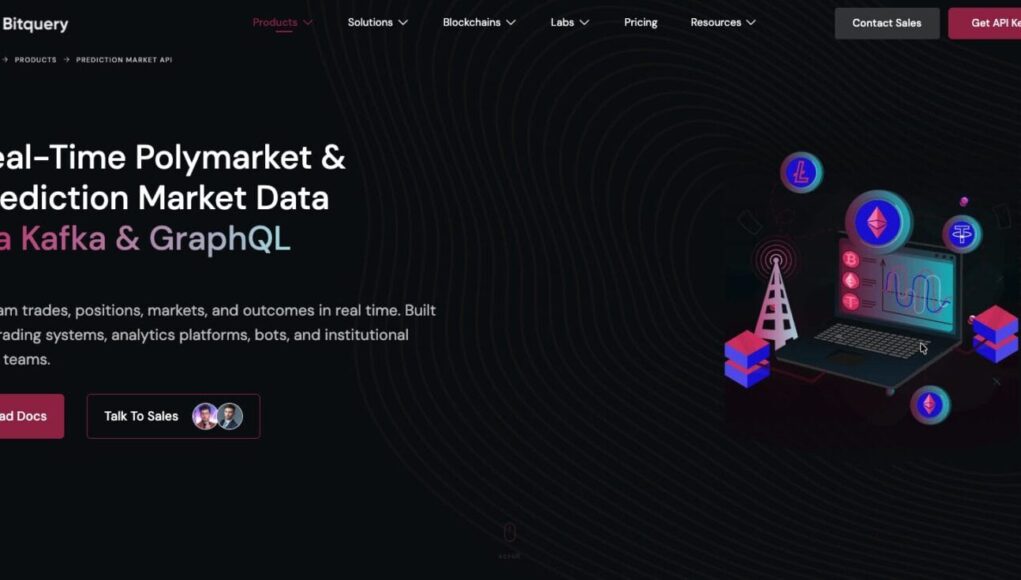
Bitquery Polymarket APIs provides the only unified API indexing complete prediction market lifecycles across Polymarket and expanding to other prediction markets. Unlike platform-specific APIs, Bitquery captures every stage: market creation, outcome token trades, liquidity events, and final settlements in a single unified schema so you don’t have to switch to new API every time.
Complete Market Lifecycle Coverage
| Stage | API | Key Use Cases | Sample Fields |
| Management | PredictionManagements | Track market creation/resolution | Question Title, MarketId, CollateralToken, ResolutionTime |
| Trades | PredictionTrades | Wallet activity, volume analysis | Buyer/Seller wallets, Collateral Amount, IsOutcomeBuy, PriceImpact |
| Settlement | PredictionSettlements | P&L calculation, redemption tracking | Holder, Redeemed Amount, Winning Outcome |
Why developers choose Bitquery:

- Universal indexing: One API for Polymarket + future chains (no multi-subgraph headache)
- Trade directionality: IsOutcomeBuy flag reveals bullish/bearish wallet conviction
- Pagination + time filters: Query any date range, any market, any wallet
- IDE-ready: Paste, run, analyze (no schema guessing)
Historical analysis: Access recent trades to see buyer wallet addresses, CollateralAmount (USDC staked), Question title (“Will ETH hit $5k by Q2 2026?”), and trade timestamps.
Live trading: Use the real-time GraphQL subscription with this response breakdown:
- Buyer/Seller: Wallet addresses trading outcome tokens
- CollateralAmount: USDC amount staked per trade
- IsOutcomeBuy:
true=Yes tokens bought, false=No tokens bought/sold
- Question.Title: “Trump wins 2028?”
- MarketId: Unique market identifier
- Outcome.Label: “Yes” or “No”
Kafka Streams (Mempool + Confirmed)
Bitquery offers two Kafka topics for high-frequency trading latency:
- matic.predictions.proto: Raw prediction market events
- matic.broadcasted.predictions.proto: Mempool data (see trades before blockchain confirmation)
Sample payload: View Kafka data structure
Pricing at Scale
Bitquery’s pricing model is designed to not penalize you for scaling. Unlike providers that charge based on data volume or compute units, Bitquery streams are priced per stream, not per byte or message.
For Polymarket monitoring, a production system tracking 1,000 active markets at 1 trade per second generates roughly 14.19 billion compute units per year under a volume-based model, costing upwards of $56,265 annually with byte-based providers. With Bitquery, the same coverage runs through a single stream at a fixed price, regardless of:
- Number of markets monitored
- Trade frequency or message volume
- Total data throughput
For latency-sensitive systems, Bitquery’s Kafka stream is about 500 ms faster than its WebSocket stream, delivering prediction market events within roughly 0.1 seconds of block confirmation. In benchmark tests, the Kafka stream also achieved 100% data coverage with zero missed events, while WebSocket-only ingestion can drop messages during high-burst periods.
Learn more about how stream pricing behaves at scale:
Running Thousands of WebSockets for Real-Time Prices
2. Polymarket Native API
Best for: Real-time orderbook data, low-latency trading bots
Polymarket’s native API delivers orderbook depth, trade streams, and implied probability pricing with WebSocket latency under 50ms, ideal for high-frequency strategies.
Key features:
- REST + WebSocket endpoints
- Orderbook depth (10+ levels) and live trade streams
- Implied probability pricing from outcome token ratios
- EIP-712 signed orders for on-chain execution
- Market resolution and settlement tracking
3. Kalshi API
Best for: Regulated U.S. event markets, institutional-grade data
Kalshi (CFTC-approved) offers REST/WebSocket/FIX access to macro, climate, and policy markets, familiar to traditional finance developers.
Key features:
- REST, WebSocket, FIX protocol support
- Official Python/JavaScript SDKs
- Sandbox environment for testing
- Historical settlement datasets
- Economics/policy event coverage
4. Augur API
Best for: Fully decentralized, transparent on-chain prediction data
Augur v2 indexes every market state and resolution event directly on Ethereum, perfect for research requiring full transparency.
Key features:
- On-chain data via RPC/indexers
- Complete market lifecycle transparency
- Liquidity and reporter voting data
- Rich historical archives
5. Manifold Markets API
Best for: Social forecasting, sentiment data, academic research
Manifold’s play-money markets produce bias-resistant probabilities across unlimited topics. Public read API, no authentication needed.
Key features:
- High-rate public API (no auth barriers)
- Social-driven probabilities
- Extensive historical outcomes
- Clean JSON format for AI/research
6. Zeitgeist API
Best for: Polkadot-native forecasting with governance resolution
Zeitgeist combines prediction markets with on-chain governance, indexable via SubQuery, good for Substrate developers.
Key features:
- Polkadot/Substrate native API
- Governance-driven market resolution
- Cross-chain forecasting markets
- SubQuery indexing support
Comparison Table
| API | Real-Time Data | Historical Depth | Kafka/Stream | Best Use Case |
| Bitquery | Yes (GraphQL + Kafka) | Deep | Yes | Trading, Algo bots, alpha discovery |
| Polymarket | Yes (WebSocket | Strong | No | HFT bots, arbitrage |
| Kalshi | Yes (WebSocket + FIX) | Strong | No | Regulated analytics |
| Augur | Yes (RPC) | Very deep | No | Transparent research |
| Manifold | Yes | Strong | No | Sentiment research |
| Zeitgeist | Yes | Deep | No | Governance forecasting |