
Disclaimer: This article is for informational purposes only and does not constitute financial advice. BitPinas has no commercial relationship with any mentioned entity unless otherwise stated.
📬 Get the biggest crypto stories in the Philippines and Southeast Asia every week — subscribe to the BitPinas Newsletter.
This article is part of our Consensus HK 2026 Coverage
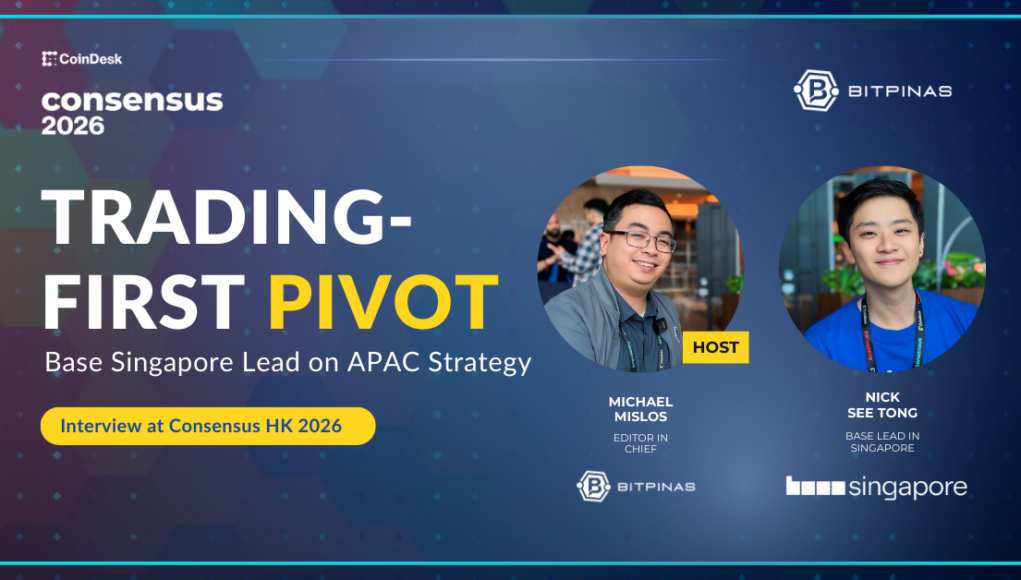
As the crypto industry continues its pivot toward consumer applications, Base — the Layer 2 blockchain incubated by Coinbase — is doubling down on a “trading-first” strategy to drive growth in the Asia-Pacific region.
In an exclusive interview with BitPinas at Consensus 2026, Nick See Tong (LinkedIn, X), the Country Lead for Base Singapore, outlined the network’s evolving vision, the role of AI agents, and why the ecosystem remains unfazed by the relentless speculation surrounding a potential token airdrop.
A Pivot to ‘Trading First’

While Base initially made waves with its “Onchain Summer” campaigns focused on art and creators, Nick revealed and explained the shift toward trading within the Base app.
“By focusing on a trading-first strategy… we are putting capital to projects on Base. There’s a liquidity flywheel that we can unlock by getting more traders moving capital and investing in promising projects.”
He noted that this pivot addresses a gap in the previous creator-centric model and thus ensures builders will have access to the deep liquidity needed to scale.
On Airdrops and ‘Mercenary’ Capital
Wen Base Airdrop?
When asked about the constant community speculation regarding how the Base token airdrop will happen, Nick opted to explain how the real Base community thinks about the upcoming token drop:
- First, he emphasized that Base spent its first two years explicitly stating there would be no airdrop, which helped attract “real builders” rather than just speculators.
- “The people that we attracted… they’re all real builders,” he said while recounting an event with Base creator Jesse Pollak where, out of 500 attendees, only one person asked about a token.
Most web3 projects, whether they admit it or not, view airdrop farmers as mercenaries who would leave once the tokens are received.
However, Nick acknowledged that airdrop farmers actually have a functional role in the ecosystem. He thought it was actually the job of the projects to find a way to retain them after the airdrop:
“Airdrop farmers are not bad. They do serve an important role in building up liquidity… and provide projects with their first couple hundred users. If a project can’t retain the airdrop farmers, then maybe there’s just no product-market fit.”
Singapore vs. SEA: Finance vs. Gaming

Discussing the regional landscape, Nick highlighted a distinct divergence between Singapore and its neighbors.
“Singapore, Hong Kong, and Dubai serve as the capital for funding,” he observed. “But where we see good builders come from is really places like Malaysia, Indonesia, and the Philippines.”
He noted that Singapore-based projects tend to be “finance-centric,” focusing on DeFi and financial instruments, while builders from the Philippines and Indonesia are more inclined toward gaming and consumer applications.
The Rise of AI Agents
Base is also positioning itself as a home for the burgeoning “Agentic Economy” where AI agents autonomously transact on-chain. Nick pointed to Virtuals Protocol, which is a project with Malaysian roots, as a prime example of this success.
“By 2028, 70% of the workforce will have some sort of generative AI embedded,” Nick predicted. He highlighted Coinbase’s developer tools (such as AgentKit) that allow agents to plug into the blockchain for micropayments, effectively giving AI a bank account.
Base App and UX
Nick also teased features of the new Base App, describing it as a “general release” aimed at radically simplifying the user experience.
Key features include:
- Passkey Integration: Transactions are signed via FaceID. This eliminates the need for constant wallet approvals.
- On-Chain Analytics: The app uses tools to analyze wallet history and surface relevant projects to the user.
- Merchant Integration: Partnerships with platforms like Shopify allow for seamless USDC payments on Base.
Base vs. Solana
Addressing the competitive landscape, particularly the rivalry with Solana, Nick maintained that the industry is early enough for multiple winners.
“It’s just like Visa and Mastercard,” he said.
However, he distinguished Base by its “credibility” and alignment with compliance, attributes he argues make it the preferred choice for institutions:
“If you were an institution looking for a blockchain that has credibility, I think Base is one of the first few chains that come to mind.”
Looking Ahead
For 2026, Nick says the focus in APAC will be on expanding engagement with trading Key Opinion Leaders (KOLs) to support the network’s new strategic direction.
“It’s going to be a very exciting year for everyone,” he concluded.
This article is published on BitPinas: Interview: Base Singapore Lead Details ‘Trading-First’ Pivot and APAC Strategy
What else is happening in Crypto Philippines and beyond?