


Most token launches fail before they ever reach a real market. The pattern is familiar: a creator deploys liquidity on day one, bots front-run the launch, early holders dump within the first hour, and the chart looks like a cliff before the community has had any time to form. Catapult Trade was built specifically to break that pattern. It is a structured token launchpad that separates the prove-demand phase from the deploy-liquidity phase, meaning creators earn the right to an on-chain market by generating real trading volume in a simulated environment first. This guide walks through exactly how to launch a token on Catapult, from wallet setup through graduation, so you know what to expect at every step before you commit a single dollar to the process.
What Is Catapult Trade?

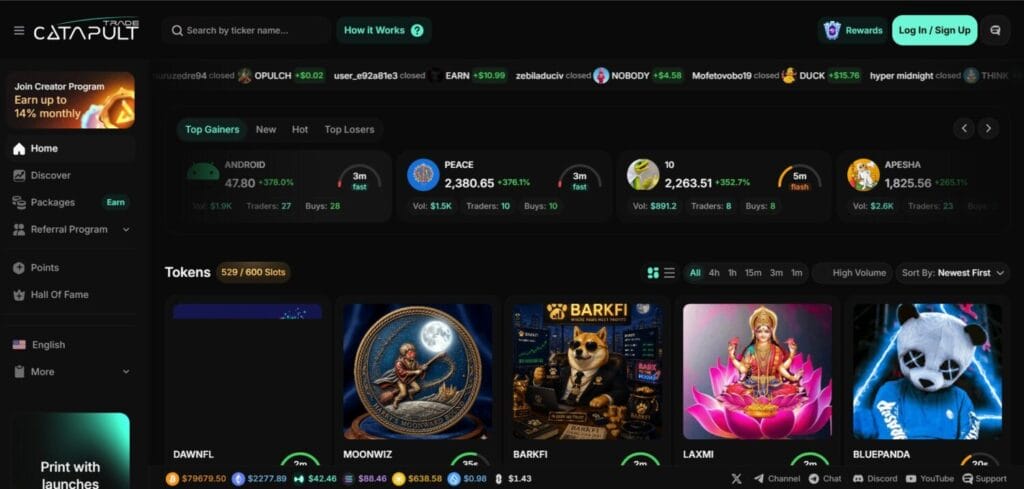
Catapult is a token launchpad built on HyperEVM, using Hyperliquid as its L1 trading environment and LayerZero for cross-chain interoperability. Since its full launch in December 2025, the platform has recorded over $1.1 billion in cumulative trading volume and 77,000 monthly active users, with KuCoin Ventures investing in March 2026. The core architecture is built around a two-phase system: Catapult Turbo, a simulated environment where tokens prove demand before touching on-chain liquidity, and Catapult Hyper, the live infrastructure where graduated tokens deploy as Omnichain Fungible Tokens (OFTs) across multiple chains.
The fee model is transparent and fixed: 1% on collateral and 4% on winning position profits. Revenue sharing is built into the architecture, meaning creators, traders, and the platform all benefit from activity rather than the platform extracting value from creators at launch.
Steps to Launch a Token on Catapult Trade

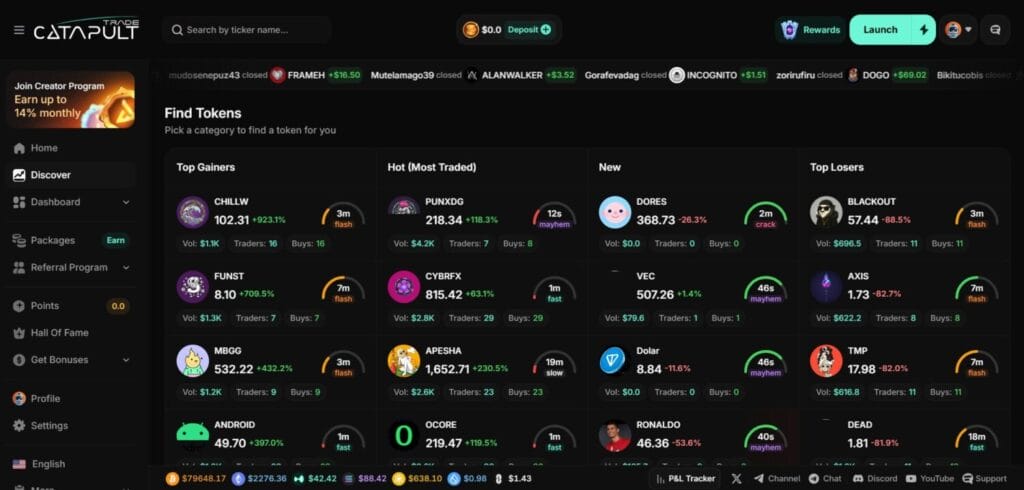
Step 1: Connect Your Wallet
Catapult supports MetaMask and any WalletConnect-compatible wallet.


- Navigate to the main website.
- Click the connect button in the top right corner, and select your preferred wallet provider.
- The platform runs on HyperEVM, so you will need to add the HyperEVM network to your wallet if it is not already configured. Network details are available in the platform’s documentation.
Before proceeding to token creation, fund your wallet with enough HYPE or the required collateral asset to cover the flat launch fee for your chosen Turbo volatility tier. Amounts vary by tier and are displayed clearly during the token creation flow, so you will see the exact cost before confirming.
Step 2: Understand the Two-Phase System

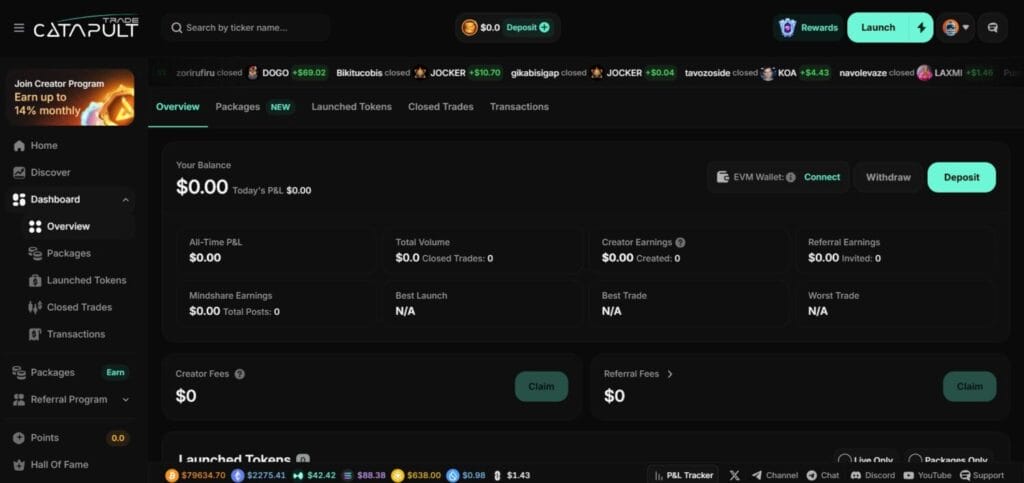
The most important thing to understand before launching on Catapult is that the platform operates in two distinct phases, and confusing them leads to misaligned expectations.
- Catapult Turbo is where every token begins. Turbo is a simulated, deterministic trading environment where price action is generated by a geometric Brownian motion mathematical engine rather than a live order book. Traders buy and sell against the protocol vault with instant execution and zero slippage. The creator selects a volatility tier at launch, pays a flat fee, and the session runs inside a fixed time window. Because price movement is decoupled from liquidity, early buyers cannot front-run with MEV bots, and the creator has no mechanism to manipulate the chart. Turbo is not a demo mode or a sandbox — it is the demand-proof layer that every token must pass through before going live.
- Catapult Hyper is the on-chain infrastructure layer where tokens graduate after proving sufficient demand in Turbo. Graduated tokens are deployed as OFTs using LayerZero, making them natively multichain from day one across Hyperliquid, Ethereum, Arbitrum, Base, and other supported networks. The liquidity pool deploys automatically when the graduation threshold is reached, and the bootstrapping model scales capital requirements with market cap rather than requiring a fixed upfront liquidity commitment from the creator.
Step 3: Create Your Token in Turbo
From the Catapult dashboard, navigate to the token creation interface and fill in your token’s name, ticker, description, and upload an image. These details are permanent once submitted, so take time to get them right. Next, select your volatility tier. Each tier defines the price volatility range the mathematical engine will generate during the Turbo session, the session duration, and the flat creation fee. Higher volatility tiers generate more aggressive price action, which attracts more active traders but also carries more risk for early holders.
Once you confirm and pay the flat creation fee, your token’s Turbo session goes live. From this point, your role as creator is community building and mindshare generation, not price management. You cannot influence the Turbo chart price in any way. What you can do is drive awareness, bring traders into the session, and generate the volume needed to reach the graduation threshold.
Step 4: Build Mindshare During the Turbo Session
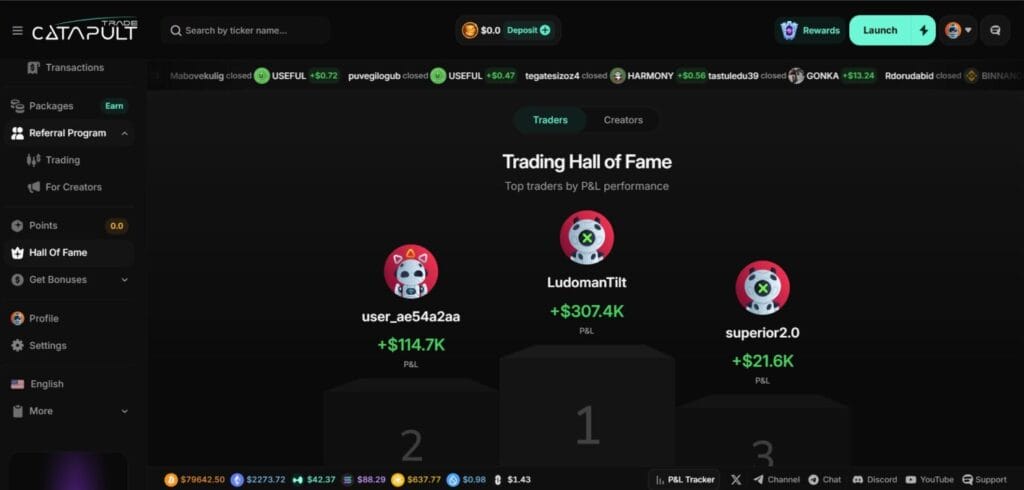
The graduation threshold in Turbo is volume-based, not time-based. Tokens that generate sufficient trading activity within the session window graduate to Hyper. Tokens that do not reach the threshold enter a Reactivation window — a second opportunity with increased contribution requirements. Tokens that fail the Reactivation window are retired permanently, which prevents zombie tokens from clogging the platform and diluting attention from active launches.
This structure means that the quality of your community building during the Turbo session is the single most important variable in whether your token graduates. Effective tactics include launching with an established audience on social platforms, coordinating with DeFi communities and content creators who can bring traders to the session, and using Catapult’s built-in growth tools including the points system and referral infrastructure. The platform’s points system rewards active engagement and was designed as a retention layer funded by platform revenue rather than speculative token incentives.
8572For creators who have studied community-driven launch mechanics on platforms like Pump.fun or explored on-chain token distribution strategies through resources like CoinCodeCap’s DeFi guides, the Turbo phase will feel familiar in intent but structurally fairer in execution.
Step 5: Graduation and Hyper Deployment
When your token hits the graduation threshold, Catapult automatically deploys it to the Hyper on-chain environment. No manual action is required from the creator at this point. The liquidity pool forms automatically from the accumulated volume and capital in the Turbo session, and the token becomes tradeable on the live Hyper terminal.
Graduated tokens are deployed as OFTs via LayerZero, which means they are natively omnichain from the moment of graduation. Traders on Hyperliquid, Ethereum, Arbitrum, and Base can access the token without bridging or additional deployment steps. The Hyper terminal functions as a discovery engine, connecting graduated tokens with the broader ecosystem of traders and creating a compounding loop between creator mindshare and on-chain liquidity depth.
Revenue sharing activates in Hyper. Creators earn from trading volume generated on their token, traders earn from successful positions, and the platform takes its fixed fee. The incentive structure is aligned from day one of the on-chain phase rather than extracting from early buyers to compensate insiders.
What to Know Before You Launch

Catapult is genuinely more creator-friendly than most launchpad alternatives, but it is not without risk. The simulated Turbo environment means early traders are not committing real liquidity, which makes the proof-of-demand signal a proxy rather than a guarantee of real market interest. A token can graduate with strong Turbo volume and still face thin liquidity in Hyper if the Turbo participants do not follow through to on-chain trading.
The platform is also relatively new. The full launch happened in December 2025, and while the track record so far includes no documented withdrawal problems or evidence of price manipulation, six months of operating history is not the same as the years of battle-testing that established DeFi infrastructure carries. The Q1 2026 server incident, which affected roughly 1,675 users during a two-hour window before same-day refunds were issued, is the most relevant data point for how the team handles operational failures.
Conclusion
Catapult’s Turbo-to-Hyper architecture is the most structurally sound approach to fair token launches available on any launchpad in 2026. Volume becomes proof. Graduation becomes merit. Liquidity becomes earned rather than gamed. For creators who have watched well-intentioned projects get front-run and dumped on every other platform, the enforced demand-proof phase is not a barrier — it is the point. Connect your wallet, choose your volatility tier, build your community during the Turbo session, and let the graduation mechanic filter out the noise. That is the Catapult model, and on the evidence of $1.1 billion in volume since December 2025, it is working.
Frequently Asked Questions (FAQs)
How much does it cost to launch a token on Catapult?
Catapult charges a flat creation fee that varies by the volatility tier you select for your Turbo session. The exact fee is displayed during token creation before you confirm the transaction. There are no hidden costs beyond the flat fee and standard network gas charges on HyperEVM.
What happens if my token does not graduate from Turbo?
If a token does not reach the graduation volume threshold within the session window, it enters a Reactivation phase where a second attempt opens with increased contribution requirements. If the Reactivation phase also fails, the token is permanently retired. This prevents zombie tokens from cluttering the platform and diluting attention from active launches.
Can the creator manipulate the Turbo price chart?
No. Turbo price action is generated by a deterministic geometric Brownian motion mathematical engine that runs independently of any participant’s actions. Creators and traders both interact with the protocol vault, and neither has any mechanism to influence the price direction during the Turbo session.
What chains does Catapult support after graduation?
Tokens that graduate from Turbo are deployed as Omnichain Fungible Tokens via LayerZero, making them natively multichain across Hyperliquid, Ethereum, Arbitrum, Base, and other supported networks from the moment of graduation. No additional bridging or deployment is required from the creator.
Is Catapult Trade safe to use?
Catapult has recorded over $1.1 billion in cumulative volume since its December 2025 launch with no documented withdrawal problems or evidence of price manipulation. KuCoin Ventures invested in March 2026. A Q1 2026 server incident affecting roughly 1,675 users was resolved with same-day refunds without users needing to request them. As with any DeFi platform, smart contract risk and market volatility apply, and participants should only commit funds they can afford to lose.


