

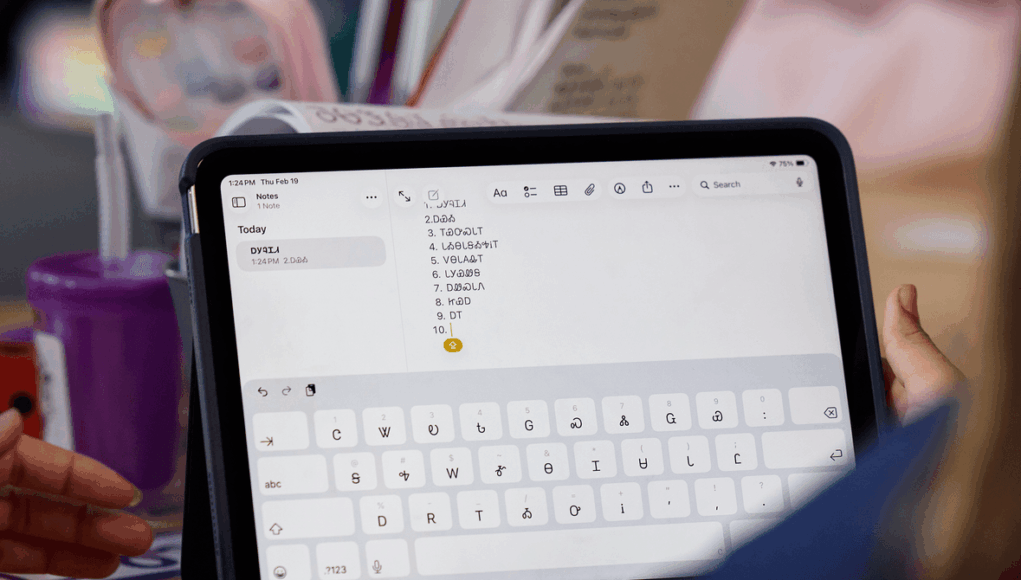
Chuck Hoskin Jr. fondly recalls watching a room full of Cherokee immersion students crowd around a screen to watch How to Train Your Dragon. Except Hiccup and Astrid weren’t speaking English—the protagonists were speaking Cherokee, dubbed by voices from the local community.
“They’re hearing it in our mother tongue—that didn’t happen a generation ago,” Hoskin Jr., principal chief of the Cherokee Nation, tells WIRED. “We’re a long way, thankfully, from rote classroom instruction and memorization to a world where kids can see the sort of creativity that sparks imagination and helps every kid become more articulate and literate.”
The Cherokee Nation has around 1,500 active speakers left, and most are over 70. Hoskin Jr. says the community is rapidly losing that generation, which is why it has spent time training up second-language learners. It even has a baby immersion program, hoping their first words are Cherokee.
“The foes we’ve had historically are the so-called Age of Discovery, colonization, the displacement of our people economically and geographically, boarding schools,” he says. “But it’s nothing compared to the mathematics we’re up against now. Which is why we’re filled with this urgency every day to do all we can to find partners that can help us accelerate what we want to do.”
One of those accelerants is Apple. The Cherokee Nation has long collaborated with the iPhone maker, and Cherokee was the first Native American language included in iOS in 2010. Today, Apple says its iOS keyboard supports more than 200 languages and language variants, with a handful added last year in iOS 26, like Haitian Creole and Nez Perce. In iOS 27, it expanded support for Indigenous languages to include other Native American languages like Blackfoot, Comanche, and Northern East Cree.
The goal is to meet young people where they already spend much of their waking hours: phone screens. Hoskin Jr. says that to revitalize and save a language, it has to become accessible. Apple says the effort isn’t as simple as translating words. It’s a multi-year endeavor that requires deep research, and the company leans on community members for their expertise.
But the process doesn’t start in Cupertino. It actually begins with Unicode. You may have heard of the name—it’s the organization that approves and standardizes the new emoji that appear on your smartphone every year. It also handles time zone localization, currency names, imperial versus metric, and so on.
Before you can type or read a character on a smartphone screen, it needs to exist as a recognized character in the Unicode Standard. “Everything does start with Unicode in terms of a language, but it actually starts with characters and scripts,” says Unicode CEO Toral Cowieson. “We now have more than 157,000 characters that are included.”