
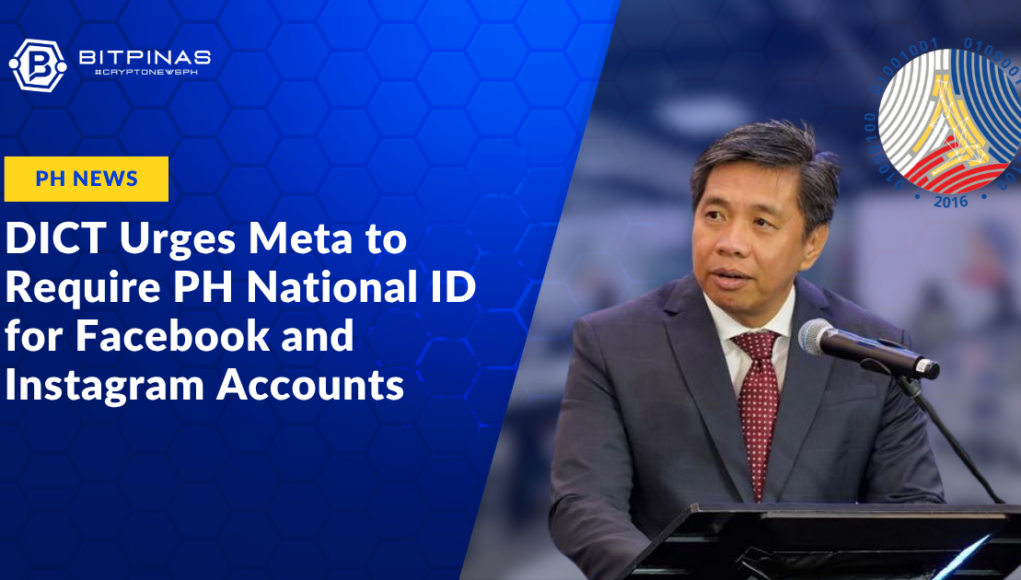
Anonymous social media accounts in the Philippines may soon be a thing of the past if the government gets its way. The Department of Information and Communications Technology (DICT) is formally pushing Meta to integrate the Philippine National ID (PhilSys) into its account verification process across Facebook, Instagram, Messenger, WhatsApp, and Threads.
The initiative aims to solve a long-standing challenge in digital law enforcement: attribution. By tying social media accounts directly to government-verified identities, officials hope to eliminate the anonymity that allows individuals to commit crimes online without facing immediate identification.
Leveraging Roblox as a Benchmark
During a recent bilateral meeting in Singapore, DICT Secretary Henry Aguda urged Meta executives to adopt identity verification standards similar to those promised by the gaming platform Roblox.
While Meta pushed back on the request, citing lengthy technical procedures and operational complexity, the DICT emphasized that technical excuses will carry little weight once other global platforms demonstrate feasibility. The government’s position is simple: if gaming platforms can verify real-world identities, social media giants have no justification for delaying similar protections.
AI Failures Trigger Government Scrutiny
The heightened urgency follows a critical breakdown in Meta’s automated safety systems. During an August 18 attack at Ateneo de Zamboanga University, a livestream of the violence remained visible on Facebook for approximately 14 minutes before automated moderation systems detected it. (Read More: PH Government Explores Nationwide Facebook Ban Over Safety Concerns)
During that window, users copied and redistributed the footage, forcing government agencies and Meta to take down more than 1,700 reuploaded videos. While Meta attributed the delay to the small fraction of content that evades its artificial intelligence filters, DICT officials rejected the defense, stating that detection failures are unacceptable when violent crimes are involved. (Read More: PH Government and Meta Agree on Rapid-Response Pact, Shelving Facebook Ban Threat)
Legal Accountability and Local Representation
Under current Philippine law, government agencies cannot impose legal penalties or financial liabilities on foreign tech platforms for content moderation failures. To address this legal void, the Senate is developing the Child Online Safety and Protection Act, a priority legislative measure intended to establish statutory liability for social media companies operating in the country.
In response to the diplomatic push, Meta committed to sending a technical working group to the Philippines to collaborate with the National Bureau of Investigation (NBI) and the Cybercrime Investigation and Coordinating Center (CICC).
Meta also indicated a willingness to establish an official corporate entity in the Philippines if explicitly required by upcoming legislation, which would streamline local law enforcement requests. The DICT is simultaneously expanding its regulatory focus to cover other communication channels, including Discord, over concerns regarding unmonitored messaging spaces.
Source: (1)
This article is published on BitPinas: DICT Urges Meta to Require Philippine National ID for Facebook and Instagram Accounts
What else is happening in Crypto Philippines and beyond: