


Key Takeaways:
- The National Bank of Rwanda warned on April 5, 2026, that Bybit’s new FRW P2P feature violates the country’s crypto rules.
- NBR-licensed banks are prohibited from converting FRW to crypto, leaving users with zero legal recourse for losses.
- Rwanda’s Cabinet approved a draft VASP licensing framework on March 4, 2026, which could reshape crypto access rules.
National Bank of Rwanda Issues Crypto Warning
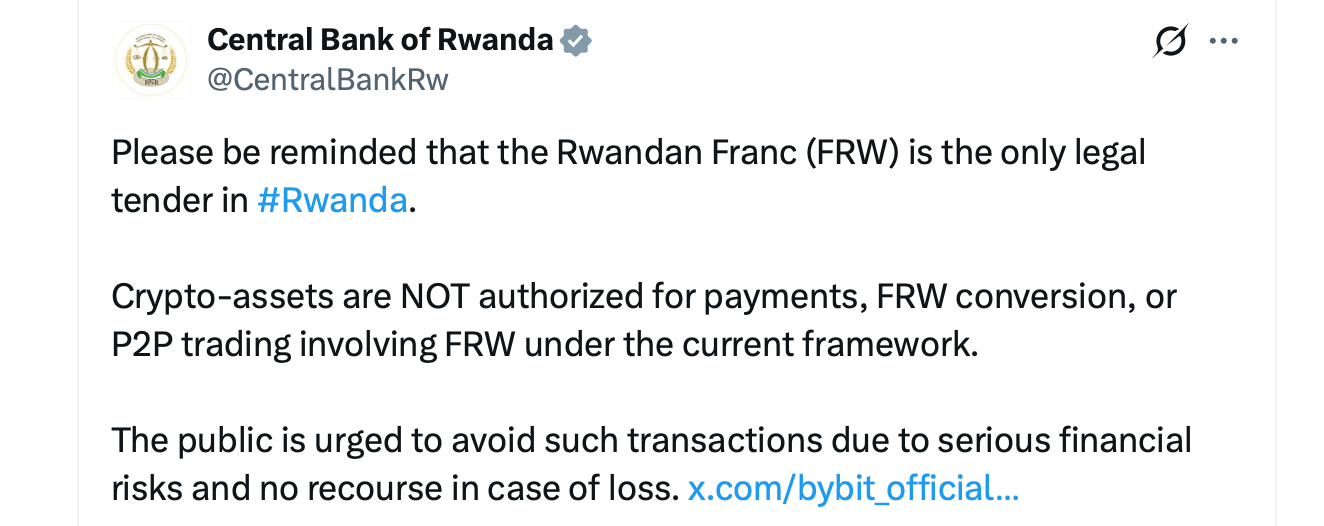
The National Bank of Rwanda, also known as the BNR, posted two statements (1, 2) on X addressing what it called “recent social media promotions” tied to crypto trading involving the local currency. The bank stated that the Rwandan franc remains the country’s only legal tender and that crypto-assets are not recognized as a means of payment under current law.
Bybit announced on April 2, 2026, that the Rwandan franc was live on its P2P trading platform. The exchange promoted the launch with rewards for new users and bi-weekly commissions for merchants willing to facilitate trades.
The BNR’s response was direct. It stated that NBR-licensed financial institutions are prohibited from converting FRW into crypto-assets or vice versa. It also confirmed that using crypto to purchase goods and services in Rwanda is not permitted and that acting as a merchant or intermediary in FRW-linked P2P trades is unauthorized.
The bank warned that anyone engaging in such transactions “does so entirely at their own risk” and has no legal protection or recourse in the event of a loss.
Rwanda has maintained restrictions on crypto payments and FRW conversions since roughly 2018. The BNR’s April 5 statement is not a new ban. It is a public reaffirmation of existing rules, prompted by what officials described as a high-profile promotional push from Bybit.
Other international exchanges, including Binance and Remitano, have offered FRW trading pairs for years with less regulatory response. Bybit’s public promotion appears to have drawn a more visible reaction from authorities.
As of April 7, 2026, Bybit had not issued a public response to the BNR warning. The warning arrives as Rwanda advances its own digital currency initiative. The National Bank completed a proof-of-concept for an e-Franc, a central bank digital currency, and is moving into a 12-month domestic pilot. The government’s approach points toward state-controlled digital payments rather than integration with private crypto networks.
Rwanda’s Cabinet approved a draft virtual asset service provider licensing framework on March 4, 2026. The Rwanda Capital Markets Authority released the draft, which includes prohibitions on crypto mining, mixer services, and franc-pegged tokens. The bill has advanced in Parliament. Once enacted, unlicensed operations could face fines or other penalties.
The draft Virtual Asset Service Provider (VASP) framework explicitly states that crypto-assets are not legal tender. It does open a path for licensed operators, which could eventually give regulated exchanges a legal route into the market, though crypto is expected to remain outside Rwanda’s formal payment system for now.
Rwanda ranks relatively low in global crypto adoption indices, a result that reflects years of restrictive policy on payments and conversions involving the franc. Rwandan users who continue to trade crypto through P2P platforms do so outside any regulatory framework. The BNR’s message is plain: losses from scams, platform failures, or disputes have no legal remedy under current rules.