

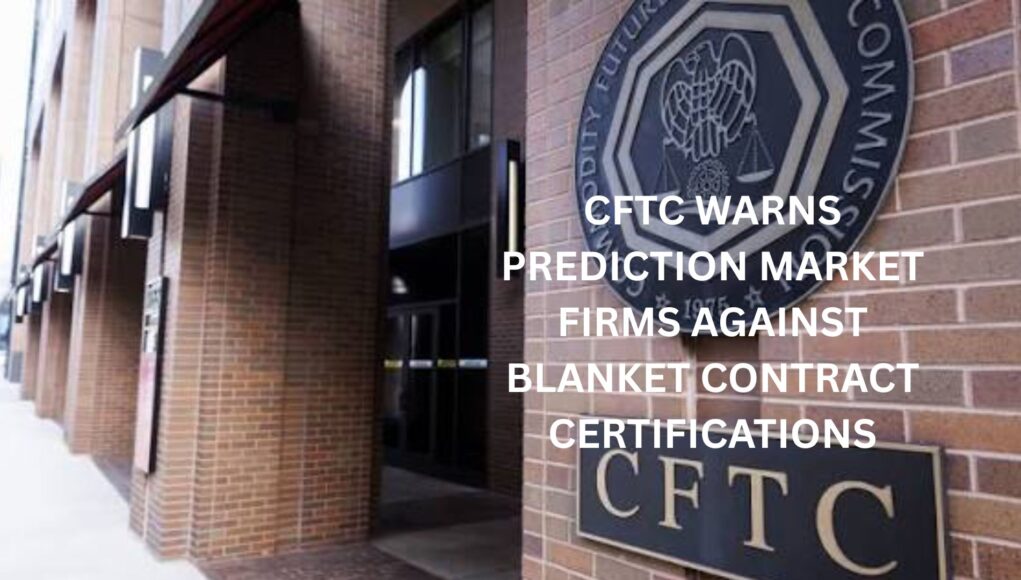
Federal regulators are again putting prediction market operators on notice over how they file new products for approval. In a latest development, the Commodity Futures Trading Commission (CFTC) issued an advisory Friday directed at leading firms including Kalshi, Coinbase, Polymarket, and Crypto.com, cautioning them against a practice the agency says has become common which is lumping multiple versions of an event contract into a single, generic certification rather than filing each one on its own terms.
CFTC has flagged the self-certification process, which lets exchanges bring new contracts to market without waiting for the agency’s prior sign-off, provided they meet the requirements laid out in the Commodity Exchange Act. According to officials, they have noticed platforms submitting what amounts to one filing covering many different contract variations at once, each potentially settling through different sources or methodologies, without breaking out the specific terms of each version or explaining how it complies with the law.
According to the CFTC, the provision strips regulators of the ability to evaluate what they’re looking at. Without a detailed, contract-by-contract breakdown covering settlement mechanics, the underlying commodity, and legal compliance, officials say there’s no meaningful way to confirm that every permutation bundled into a filing actually meets the standard. Friday’s notice reiterated that this kind of broad, one-size-fits-all certification isn’t acceptable, echoing a nearly identical warning the agency put out in March this year.
However, CFTC was also explicit that platforms still retain their statutory right to self-certify event contracts without needing commission approval upfront, even as the agency amid the agncy working through a separate rulemaking process around how prediction markets should be regulated.
The advisory landed just days before a July 27 deadline for public comments on a related CFTC rule proposal. The proposal is meant to spell out how the CFTC plans to use its power under Section 5c(c)(5)(C) of the Commodity Exchange Act, or the Special Rule and gives the agency authority to block registered derivatives exchanges from listing event contracts tied to certain categories of activity, if CFTC determines those contracts are contrary to the public interest.