Key Takeaways
- Bitcoin mining just got a whole lot tougher, with difficulty climbing 5.92% to 140.58 trillion, its highest reading since March 5 and the third-largest increase of 2026.
- Better mining revenue brought more computing power back into the competition, pushing Bitcoin’s hashrate above 1 zettahash per second (ZH/s), even as daily earnings have recently cooled.
- Another sizable difficulty increase could be around the corner on Oct. 28, with early estimates pointing to a 14.24% jump, although there’s still plenty of time for that figure to change.
Bitcoin Mining Difficulty Hits Seven-Month High After 5.92% Increase
The network’s difficulty, basically how hard miners must work to find the next Bitcoin block, increased from 132.72 trillion to 140.58 trillion. It was the third-largest increase of the year and continued a recovery that began over the summer. Metrics show that Bitcoin has logged a total of 21 difficulty adjustments this year, with the latest being the 10th rise.
The increase coincided with bitcoin’s price spike, which led to better revenue for miners. On Sept. 16, the hashprice, which measures the estimated daily revenue generated by a single petahash per second (PH/s) of computing power, stood at $37.56 before climbing above $41 on two occasions over the past 30 days, including Oct. 2.
Bitcoin Hashrate Reclaims 1 ZH/s
For much of the past 30 days, mining revenue hovered between 6% and 9% above its Sept. 16 level, but by Friday, Oct. 16, the hashprice had retreated to $36.75 per petahash per second. The improved revenue environment encouraged greater miner participation, propelling Bitcoin’s total network hashrate back above 1,000 exahash per second (EH/s), equivalent to 1 zettahash per second (ZH/s).

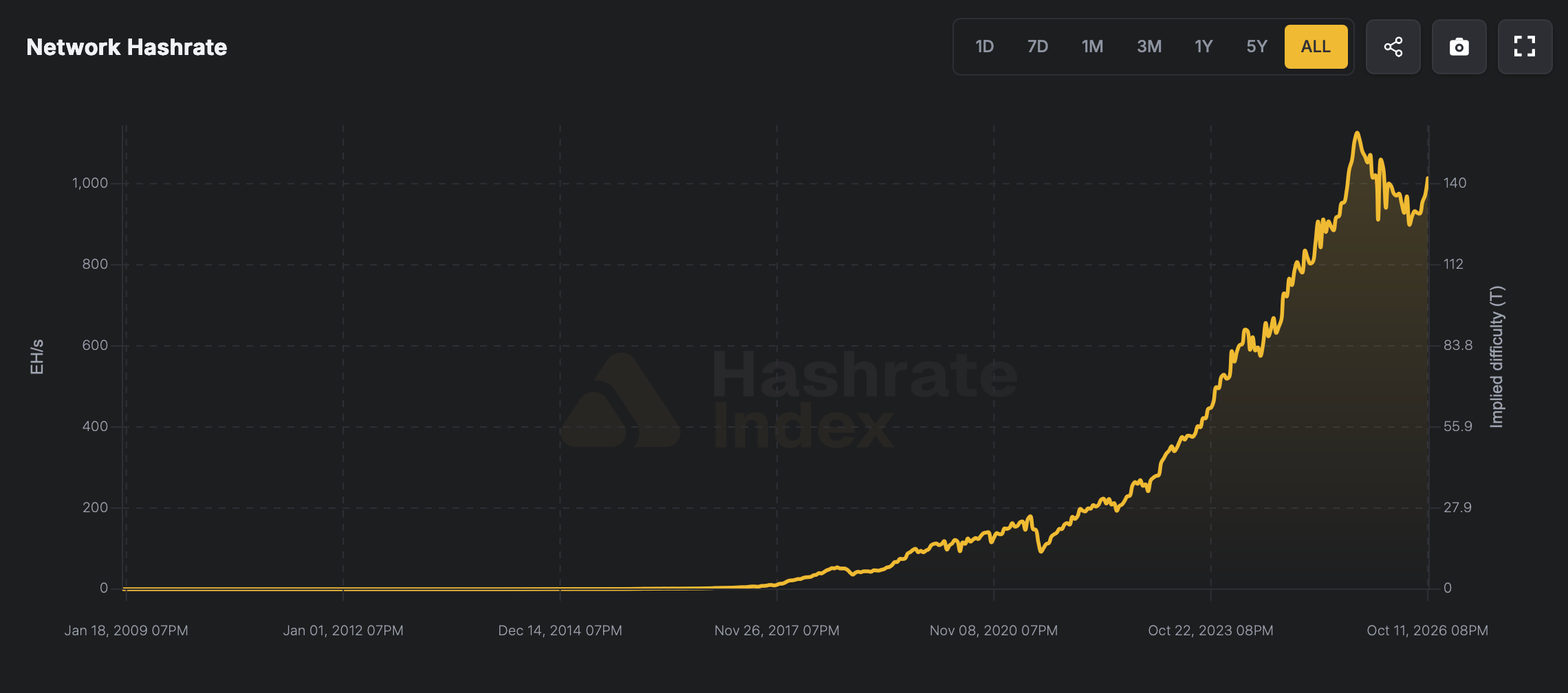
This resurgence in computing power has driven mining difficulty higher, as an expanding hashrate generally accelerates block production, prompting an upward difficulty adjustment when the 2,016-block epoch concludes ahead of schedule. Conversely, a declining hashrate slows block production, leading to a downward adjustment in difficulty. At the time of writing, the hashrate is coasting along at 1024.96 EH/s with block times around 8 minutes 45 seconds.
If the next epoch is mined faster than usual, then the difficulty adjustment due on or around Oct. 28, 2026 is expected to see an estimated 14.24% rise. But with only a few dozen of the 2,016 blocks mined so far, that projection could very well change considerably.