


Apex Trader Funding Review breaks down a popular futures prop firm model where you pass a rules-based evaluation, trade a performance account, and withdraw profits using structured payout criteria.
What is Apex Trader Funding?
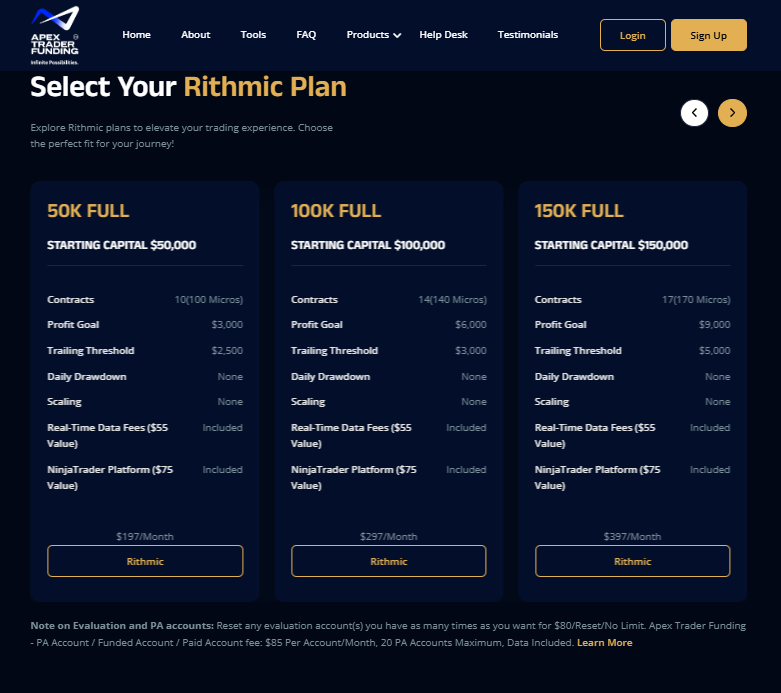
- Apex Trader Funding is a futures prop firm style program where traders subscribe to an evaluation account, hit a profit target, follow drawdown rules, and qualify for a Performance Account.
- The firm emphasizes a trailing threshold drawdown approach rather than a daily drawdown limit on many “Full” accounts, which changes how risk should be managed intraday.
- Trading is presented as simulated for evaluation and program purposes, meaning you are proving consistency and rule compliance rather than trading live firm capital directly.


Table: Common account options snapshot
| Account size | Max contracts | Profit target to pass | Drawdown rule (simple meaning) | Who it suits |
| 25K Full | 4 | $1,500 | Trailing: your “loss limit” follows your best balance up until it stops trailing, so early profits still need discipline | Beginners learning Apex rules with smaller size and tighter room for error |
| 50K Full | 14 | $6,000 | Trailing: more room than 25K, but scaling too fast can still trigger a fail | Traders ready to size up after proving consistent risk control |
| 150K Full | 17 | $9,000 | Trailing: bigger buffer potential, but still punishes big swings early | Intermediate traders with steady setups and controlled drawdowns |
| 250K Full | 27 | $15,000 | Trailing: higher target, higher size, mistakes get magnified | Experienced traders who already manage size and discipline well |
| 300K Full | 35 | $20,000 | Trailing: largest size and target, requires strong risk management | Advanced traders who can handle scaling without breaking rules |
| 100K Static | 2 | $2,000 | Static: your max loss limit does not trail upward, it stays fixed | Conservative traders who prefer a simpler, stable drawdown rule |
Apex Trader Funding Review: Features
- Apex runs a one-step evaluation model for futures, where you trade a simulated account, reach a defined profit goal, and avoid drawdown violations to qualify for a PA.
- The “Full” accounts center around a trailing threshold drawdown, which follows your account balance upward until it stops trailing, so early profits effectively increase your buffer.
- Evaluation requires minimum trading days, commonly seven non-consecutive trading days, which discourages one lucky session passes and pushes traders toward repeatable risk control and pacing.
- Performance Accounts add compliance around payout eligibility, commonly requiring a trading-day cadence after payout requests, so payouts are tied to consistency, not only raw profit spikes.
- Platform choice is part of the product stack, typically including Rithmic and Tradovate options, letting traders choose between a pro futures feed workflow or a more accessible browser-friendly path.
- Apex supports multi-account scaling up to a set maximum, which is attractive for traders running multiple evaluations, but it amplifies risk if you copy bad sizing across many accounts.
- Rules and help center documentation are detailed, covering evaluation mechanics, trailing drawdown behavior, payouts, and platform setup, which reduces ambiguity if you actually read and follow it.
- Payout economics are a big selling point, with traders entitled to keep 100% of the first $25,000 per account paid out, then a 90% profit split after that threshold.

Apex Trader Funding Review: Fees
- 30-day renewals: Apex evaluation subscriptions run on an automatic 30-day billing cycle that renews from your purchase date unless you cancel the subscription manually.
- Fail rules differ by account type: Evaluations keep billing even if you fail, so you must cancel to stop renewals. Performance Accounts typically stop billing if they fail, so they do not keep renewing.
- What the subscription fee covers: The monthly fee generally includes your active account access, performance tracking, market data while active, and access to the NinjaTrader license key bundled with the evaluation.
- Your stats usually carry forward: Your account balance and drawdown do not reset each month automatically. They normally carry forward through renewals unless the account is failed or reset.
- Renewal reset cutoff: If an evaluation fails before 5 PM ET on the trading day before your renewal invoice date, it can auto-reset at renewal at no additional charge. Failing after that cutoff can change what happens at renewal.
- Payments and invoicing details: Each subscription produces a separate invoice per account, and Apex provides a 72-hour window to fix failed renewal payments before the subscription is terminated.

Apex Trader Funding Review: Mobile app
- Apex itself is not a mobile app, but Tradovate-compatible account paths are positioned as browser and mobile friendly, which helps monitoring, managing positions, and checking progress away from desktop.
- For serious futures execution, most traders still prefer a full desktop setup for speed, order control, charting, and reduced fat-finger risk, especially when scaling contract counts.
- If you trade from mobile, the safest approach is using it for oversight and risk reduction actions, not for initiating large positions during volatility, news bursts, or thin liquidity windows.
Security
- Apex positions its program activity as simulated for evaluation and educational purposes, which reduces the risk of losing real capital through the prop account itself, but rule violations still matter.
- Account access security depends heavily on your platform setup, credentials hygiene, and device safety, because platform logins and trading terminals are the operational control surface.
- Payout processes use structured eligibility and method requirements, so you should treat identity verification, payout details, and support communication as sensitive operational steps.
- The most practical “security” risk is execution behavior, since trailing drawdown models punish overleverage quickly, so risk controls are your real protection layer here.
Apex Trader Funding Review: UI and UX
- The UX is largely platform-driven, meaning Rithmic-style setups feel pro and fast but more technical, while Tradovate-style paths aim for easier access across browser, Mac, and mobile.
- Apex’s dashboard and help center are central to the user experience, because tracking trading days, drawdown thresholds, and payout eligibility becomes a daily workflow, not a one-time read.
- The key UX friction point is trailing threshold understanding, because many traders misinterpret when it trails, when it stops, and how open drawdown interacts with unrealized PnL.
- The best experience comes from running a simple routine, trade small early, build buffer, avoid oversized swings, and use the dashboard to confirm you are progressing cleanly.

Apex Trader Funding Review: Affiliate, referrals, and rewards
- Apex promotes a lifetime referral fee model that pays a recurring percentage on referred customers’ evaluation plans and resets, which is designed for educators and trading communities.
- The affiliate program expects credible trading or finance presence, and typically includes tracking tools and reporting, so affiliates can monitor conversions and commission performance over time.
- For traders, the “rewards” are not points or airdrops, they are mostly promotions like evaluation discounts, cheaper resets, and periodic deals that reduce the cost of repeated attempts.
- If you rely on promos, you should still evaluate the base economics, because frequent resets and failed months can quietly exceed the cost of passing once with a disciplined approach.


Apex Trader Funding Review: Conclusion
Apex Trader Funding is built for futures traders who can follow rules, control size, and grind consistent days rather than swinging for one big win. The trailing threshold model can feel forgiving because there is often no daily drawdown on Full accounts, but it is also ruthless if you scale too early, because the trailing limit hugs your equity until you build buffer. The economics can be strong with 100% of the first $25,000 per account paid out, then 90%, but monthly subscriptions and activation fees mean time-to-pass is the real cost driver. If you have a system, it scales well. If you overtrade, it gets expensive fast.
Does Apex have a daily drawdown limit?
Many Apex “Full” accounts are commonly described as not having a daily drawdown, but the trailing threshold can still fail you quickly, so you should treat risk limits as strict.
How many trading days do I need to pass the evaluation?
Apex evaluations typically require a minimum number of trading days, often seven trading days, which pushes traders to show repeatable performance instead of one lucky session.
Can I use copy trading across multiple Apex accounts?
Many traders do, but it increases risk because one mistake replicates everywhere. If you copy, use smaller size per account and keep strict loss stops to avoid mass failures




