

With the first two films in the Avatar franchise, Cameron delivered a glorious new sci-fi world I adored getting lost in. I went gaga for every new piece of Pandoran flora and fauna the films introduced. Bioluminescent trees? Stunning. Floating mountains? Sign me up. Benevolent space whales? I think I’m in love.
These wondrous creations came to life through groundbreaking technology, much of it, like Avatar: The Way of Water‘s underwater motion capture, completely new as well. That’s a lot of “new” to go around.
So why is Avatar: Fire and Ash, the third film in the series, such a retread of what came before?
Detractors of the franchise might find that question funny. After all, a common complaint about Avatar is that it’s just FernGully or Pocahontas or Dances with Wolves, but in space. (While there are several solid criticisms of Avatar, these comparisons by themselves do not strong critiques make, but I digress.) However, Fire and Ash cannibalizes prior Avatar films’ best set pieces and story beats, resulting in a film that, while undeniably spectacular, relies too heavily on its prior installments, as opposed to the new Pandoran elements that could make it truly special.
What’s Avatar: Fire and Ash about?

Zoe Saldaña in “Avatar: Fire and Ash.”
Credit: 20th Century Studios
Fire and Ash gets off to a promising start. Jake Sully (Sam Worthington) and Neytiri (Zoe Saldaña) are still mourning their son Neteyam (Jamie Flatters), who passed away in Avatar: The Way of Water‘s climactic battle. His younger brother Lo’ak (Britain Dalton) takes the loss especially hard, believing it to be his fault.
While strong characterization is frankly the last thing I come to Avatar for, this sense of familial grief proves a grounding moment to open the film. Cameron lets the characters sit in their loss, exploring the varying degrees of rage and anguish that come with Neteyam’s death. Neytiri skews more towards the former, while Jake and Lo’ak skew towards the latter. The dynamic between them is tense as can be, as they hope to rebuild their life with the ocean-dwelling Metkayina clan without one of their core pieces.
But it’s not long before danger comes for the Sullys. This time, it’s not just in the form of humans, including Colonel Miles Quaritch (Stephen Lang), still in his resurrected Na’vi body. Instead, it’s also in the form of the Mangkwan, or Ash People, a Na’vi clan that has forsaken Pandoran goddess Eywa and conducts hostile raids on other clans.
The Ash People are the most exciting part of Avatar: Fire and Ash.

Oona Chaplin in “Avatar: Fire and Ash.”
Credit: 20th Century Studios
The Mangkwan clan offers Cameron a way to further expand on the peoples of Pandora, in the way the Metkayina clan did in The Way of Water. But while the Metkayina at least bore some resemblances to Avatar‘s forest-dwelling Omatikaya clan in terms of how they lived in harmony with Pandora, the Mangkwan are a shock to the system.
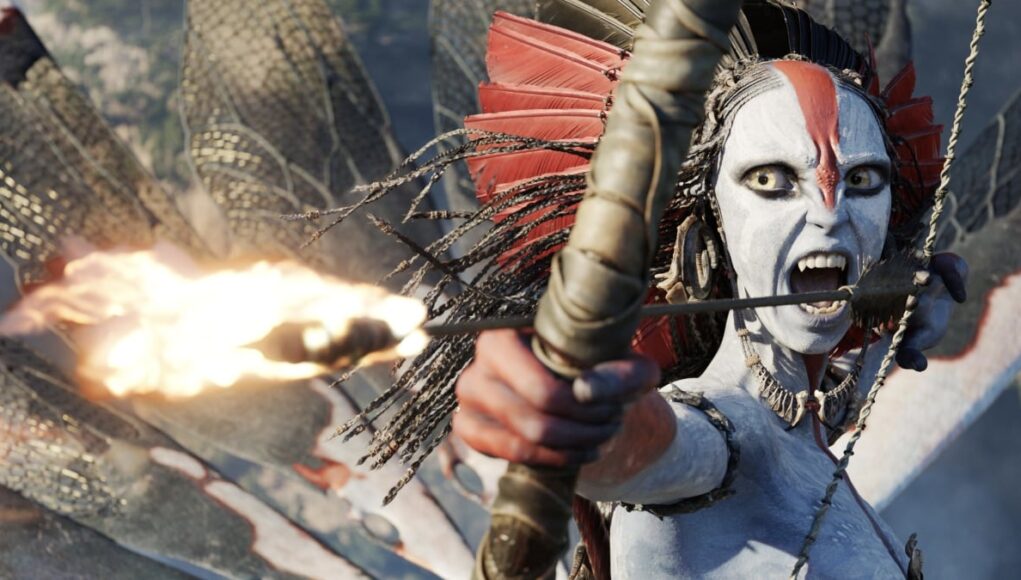
Following a disastrous volcanic eruption that wiped out their home, the Ash People turned their back on Eywa. Now, they only worship the destructive power of fire. With their ash-gray skin, striking red body paint, and warring ways, they’re a sharp contrast to the other Na’vi we’ve met.
Mashable Top Stories
Leading them is Varang (Oona Chaplin), a scene-stealing sorceress who immediately takes Fire and Ash to a new level. At times slinky and seductive, at others downright terrifying, Chaplin’s performance creates a sci-fi villainess for the ages.
She only gets better when she and the Mangkwan join forces with Quaritch. Lang reliably turns in the most fun performances in the Avatar films (nothing but respect for my Papa Dragon), and the trend continues here. He chews the scenery and spits out Southern-tinged one-liners like nobody’s business, and Chaplin more than matches his energy. As the two become more than just allies, they also morph into an intoxicating — and much more fun — foil to Jake and Neytiri’s own relationship.
Disappointingly, though, the Mangkwan get far less development than the Omatikaya or Metkayina clans. We don’t get to know a single member of the tribe in depth beyond Varang. Nor do we spend much time in their village, an impressively desolate wasteland broken up by barren trees and the jagged ruins of their volcano. For a film called Avatar: Fire and Ash, there’s far less fire and ash than I would have liked.
Avatar: Fire and Ash recycles the best parts of Avatar: The Way of Water.

I think I’ve seen this film before…
Credit: 20th Century Studios
As the Ash People fade into the background, Cameron resurfaces storylines from The Way of Water that perhaps would have been better left in the depths. Why do we need a replay of Payakan the tulkun’s undersea rescue of a trapped Lo’ak? Or of the RDA’s tulkun brain-harvesting plot? How, for that matter, did cartoonishly evil poacher Mike Scoresby (Brendan Cowell) survive getting mauled by Payakan?
These storylines worked wonders in The Way of Water. New villains in the poachers and new creatures in the tulkun set the stage for a show-stopping naval battle that still gets my heart pounding and lungs aching just thinking about it. Here, though, Cameron tries to do all that again, but bigger. Yet all I could think about for the entirety of the third act was how much it felt like The Way of Water‘s stellar conclusion — right down to the appearance of certain sets — and how much better The Way of Water pulled it off.
That final sequence, which also bears shades of Avatar‘s climactic showdown, begins to show the limits of the Avatar series. There’s only so many times we can watch Jake and Quaritch square off, or witness Pandora’s wildlife pull off a deus ex machina. Three movies in, and the stakes need to change.
Avatar: Fire and Ash is still a jaw-dropping spectacle.

Tell me that’s not the coolest thing you’ve seen.
Credit: 20th Century Studios
Here’s the thing: If I had seen Fire and Ash without having seen The Way of Water, I would have been in nonstop awe. The entire final battle is tremendous in a void — it just pales in comparison to the strangely similar set piece from its predecessor.
Thankfully, Fire and Ash gifts us with some exquisite new developments on Pandora. The Mangkwan stand out, as do the Windtraders, a nomadic people who roam around with the help of airborne medusae and windrays. When combined, these opalescent stunners form organic airships that are glorious to behold. I freaked out seeing them in the film’s first trailer, and I freaked out even more seeing them onscreen. Their skin rippling in the wind, their veins shining just underneath… Like everything else on Pandora, they’re astounding technical achievements, and I wish we got more time with them.
On the other end of the beauty scale, we have the human city on Pandora, a bustling industrial nightmare. Its hulking buildings and factories, as well as its hordes of colonizing forces, speak to an increasingly dark dystopia. A daring mission to the city gives us a deeper look at this dystopia and sparks a grittier action sequence than anything else we’ve seen in the Avatar films. Like the Ash People’s village, it’s a compelling aesthetic break from the lushness of Pandora, and a reminder of the natural beauty and ecosystems the Na’vi are fighting to preserve. It’s also a high point because it’s so different, and it’s tempting to imagine a world where this is Fire and Ash‘s finale as opposed to The Way of Water remix that we get.
Instead, Cameron returns to familiar ground, relegating all of Fire and Ash‘s most exciting newcomers except Varang (who, I can’t stress enough, still rules) to the background.
In the end, it feels greedy to ask for more from the Avatar series, with its maximalist world-building and take-no-prisoners action sequences. But after watching Fire and Ash, and with the knowledge that fourth and fifth films may be on the way, I don’t want to settle for further derivatives of the preceding films. I want the greatness I know that Avatar is capable of, so asking for more is exactly what I’m going to do.
Avatar: Fire and Ash hits theaters Dec. 19.