

Disclosure: CoinCodeCap has an affiliate relationship with Kalshi. If you open an account through a link on this page we may earn a commission, at no extra cost to you. It does not influence our rating, which is calculated from the weighted criteria published in full below.
Risk warning: Perpetual futures are leveraged products. A small adverse move can liquidate your entire margin. Event contracts can settle at zero. Nothing here is investment advice, and past volume or performance says nothing about future results.
For most of its life Kalshi was a niche curiosity: a federally regulated exchange where you could buy a contract on whether inflation would come in above 3%, settled in cash, supervised by the CFTC. Then on 3 June 2026 it listed a Bitcoin perpetual future and became the first company in American history to offer perps onshore. The product did $100 million of volume in its first 24 hours and passed $1 billion inside a week.
That single launch changed what Kalshi is. It is now two businesses stapled together: the largest regulated prediction market in the United States, and the only venue where a US resident can hold a perpetual futures position without routing through an offshore exchange. This review covers both, and it does not skip the part where Kalshi is being sued by the State of New York for a sum one analysis put north of $36 billion.
TL;DR
- What it is: A CFTC-regulated designated contract market (DCM) offering event contracts and, since June 2026, perpetual futures.
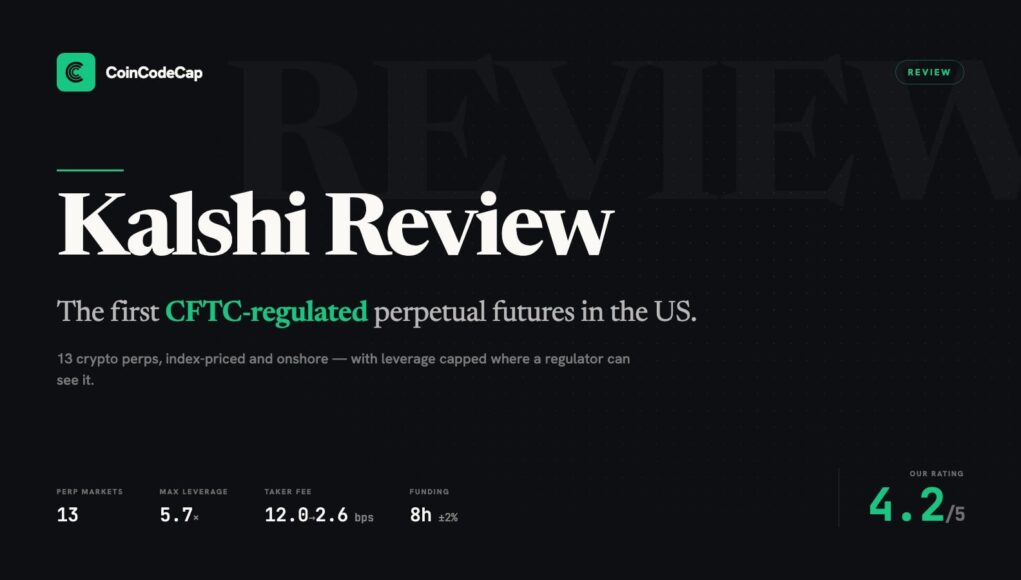
- The headline: First and only venue to list CFTC-regulated perpetual futures in the US. 13 crypto markets, priced off CF Benchmarks indices.
- Perp fees: Taker 12.0 bps down to 2.6 bps; maker 5.0 bps down to 0.6 bps, by 30-day trailing volume. Charged on notional.
- Leverage: Deliberately modest — roughly 5.7× on BTC, 4.3× on ETH, 2–3× on mid-caps. Kalshi adjusts these without notice.
- The catch: Perps are open to US residents only. There is no international access at all, and several states restrict or contest the platform.
- Best for: US traders who want leveraged crypto exposure inside the regulatory perimeter, and anyone trading macro or event outcomes.
- Not for: Non-US traders, anyone who needs high leverage or long-tail altcoins, and anyone who wants self-custody.
Kalshi at a Glance
What Is Kalshi?
Kalshi is a US futures exchange. That sentence does more work than it looks like it does, because it is the entire reason the platform exists in the form it does.

Tarek Mansour and Luana Lopes Lara founded the company in 2018 after meeting at MIT, and spent the following two years doing the unglamorous thing: applying to the Commodity Futures Trading Commission for designation as a contract market. The CFTC granted it in November 2020. That licence is what separates Kalshi from every offshore crypto venue and from crypto-native prediction markets — it is regulated as financial market infrastructure, not tolerated as an offshore business.
The original product was event contracts. You buy a Yes or No position on a defined outcome at a price between 1¢ and 99¢, and if you are right the contract settles at $1. The price is the market’s implied probability. Kalshi lists these on economics, politics, weather, company results, awards, sports and more.
The company has compounded hard on that base. A $185 million Series C in June 2025 valued it at $2 billion. A Paradigm-led round later that year took it to $11 billion and made both founders billionaires by Forbes’ count in December 2025. It is now valued at roughly $22 billion. Prediction markets as a category reached around $21 billion in monthly volume during 2026, and Kalshi holds the majority of the US share of it.
Kalshi Perpetual Futures: The Product That Changed Everything
Perpetual futures are the dominant crypto derivative. They are futures contracts with no expiry date, held open indefinitely, kept anchored to spot by a periodic funding payment between longs and shorts. BitMEX invented the format in 2016 and offshore venues turned it into a market that grew from $28 trillion of annual volume in 2023 to more than $90 trillion in 2025. Essentially none of that was legally accessible to US retail traders.
Kalshi changed that. The CFTC cleared its perpetual futures on 29 May 2026 and BTCPERP went live on 3 June. At one point the waitlist exceeded a million people. It is the fastest-growing product in the company’s history.
The 13 markets
Kalshi lists perpetuals on Bitcoin, Ethereum, Solana, XRP, Dogecoin, Chainlink, Polkadot, Litecoin, Bitcoin Cash, Sui, Stellar, Shiba Inu and Hedera. That is a deliberately conservative list. If you want to trade a perp on a token that launched last month, this is emphatically not your venue — MEXC and BYDFi list hundreds.
Every contract is priced against a CF Benchmarks index rather than a single exchange’s order book. Bitcoin uses the Bitcoin Real-Time Index (BRTI), which aggregates regulated venues and updates every second. This matters more than it sounds: index pricing from an independent benchmark administrator is materially harder to manipulate than a self-referential mark, and it is one of the clearest structural upgrades over the offshore model.
Leverage, and why it is low on purpose
Maximum leverage runs at roughly 5.7× on Bitcoin and about 4.3× on Ethereum. Mid-caps such as XRP, Solana, Chainlink, Dogecoin and Litecoin sit around 2–3×, and the smaller assets are often below 2×. Kalshi describes these limits as dynamic and can change them without notice.
Against Binance and Bybit at 125×, or MEXC at 500×, that looks feeble. It is not an accident or a technical limitation. It is what happens when a venue has to justify its risk parameters to a regulator rather than to a growth team. If your strategy depends on 50×, Kalshi cannot serve you and is not trying to.
Funding, margin and liquidation
Funding settles every 8 hours and is capped at 2% of your position per period. That cap is a genuine differentiator. On offshore venues a violently one-sided market can produce funding costs that bleed a correct directional position to death; Kalshi has put a ceiling on it.
Margin is isolated only — currently the sole mode available — which ring-fences risk to each position rather than letting one bad trade consume the account. Initial margin is set by the leverage you choose against notional size: $1,000 of BTC exposure costs $1,000 of margin at 1× and $200 at 5×, with the liquidation price moving proportionally closer to entry. Fall below maintenance margin and the position is liquidated. Variation margin, the running profit and loss, is credited or debited across two daily settlement cycles at approximately 12:00 and 16:00 ET, marked to volume-weighted average price. Behind that sits a waterfall structure with a default fund to absorb shortfalls.
One detail worth knowing: collateral held in the margin account earns approximately 3.25% APY. Idle margin on an offshore perp venue earns nothing.
Expert tip: Perps sit in a separate margin account that you must apply for. Your prediction-markets balance does not carry across, and approval is not automatic. Apply before you need the account, not when a trade is already moving.
Kalshi Prediction Markets
The event-contract business remains the larger one and the reason most people know the name. Contracts settle at $1 or $0 against a defined, verifiable outcome, and trade between those bounds in the meantime.
The categories worth caring about are macroeconomic (CPI prints, Fed decisions, GDP, jobs numbers), political, weather and climate, corporate events and sports. Macro is where Kalshi is most genuinely useful as a hedging instrument rather than a punt: a contract on the next CPI release is a cleaner expression of an inflation view than most retail alternatives.
Volume has followed. Trackers put Kalshi at roughly $6 billion of 30-day volume and a majority share of the US prediction market, with one measure placing it near 73% against Polymarket’s 27% in early July 2026. The 2026 FIFA World Cup drove a step change in sports volumes across the category.
Kalshi Fees in Full
Kalshi runs two entirely separate fee models. Confusing them is the most common mistake new users make.
Perpetual futures fees
Perp fees are tiered on 30-day trailing volume, counting perps and prediction volume combined, and charged in basis points of notional at the moment of the trade. Tiers update once per day. These figures come from Kalshi’s own fee schedule self-certified to the CFTC on 24 June 2026 and effective from 8 July 2026.
From tier 6 upward, the maker tier can alternatively be reached by supplying a minimum percentage of total perps maker volume — 0.1% at tier 6, rising to 10.0% at tier 10 — which is a market-maker provision rather than something retail will hit.
In context: a 12.0 bps entry-tier taker fee is 0.12%, against roughly 0.055% on Bybit and 0.05% on Binance. Kalshi starts more expensive for small traders and becomes competitive only at serious volume. You are paying a regulatory premium, and you should decide consciously whether it is worth it.
Prediction market fees
Event contracts use a completely different formula: round up(0.07 × C × P × (1 − P)), where C is the contract count and P is the price in dollars. The structure means the fee peaks when the market is most uncertain and falls toward zero as a contract approaches either extreme. At 50¢ the maximum is $1.75 per 100 contracts, about 1.75% of contract value. At 95¢ it is a small fraction of that.
There is no settlement fee and no membership fee. Limit orders that provide liquidity are frequently free; the charge lands on the taker.
Deposits and withdrawals
Use ACH. The 2% debit deposit fee is larger than most people’s expected edge on a trade.
Is Kalshi Safe? Regulation, Custody and the Legal Fight
On the two questions that matter for solvency, Kalshi is in a stronger position than any offshore competitor.
It is a CFTC-designated contract market, which means its rulebook, fee schedule and contract specifications are filed with a federal regulator — the fee tables above are public precisely because Kalshi had to self-certify them. Perp margin is held in protected futures accounts at Kinetic Markets, its affiliated futures commission merchant, and at the clearinghouse. That is a customer-protection structure with statutory backing. It is not the same as your balance sitting on an exchange’s own books, which is what failed at FTX.
The risk is not solvency. It is jurisdictional, and it is live.
Kalshi’s position is that its event contracts are swaps under the Commodity Exchange Act and therefore fall under exclusive CFTC jurisdiction, pre-empting state gambling law. In April 2026 the Third Circuit affirmed its preliminary injunction against New Jersey in a 2–1 decision — the first federal appellate ruling to accept that argument for sports-related event contracts. On 27 July 2026 a federal judge in Minnesota blocked enforcement of that state’s criminalising statute, with the CFTC alongside Kalshi and Polymarket.
It has also lost, repeatedly. Maryland went against it on a presumption against pre-emption. Massachusetts won an injunction in January. Ohio denied Kalshi in March. In Nevada, the same judge who had granted an injunction reversed course in November and held that sports contracts are not swaps at all. Forty-four state attorneys general contend the CFTC has exceeded its authority. The Ninth Circuit heard consolidated argument on 16 April 2026 covering Kalshi, Robinhood and Crypto.com against the Nevada Gaming Control Board.
Most seriously, New York Attorney General Letitia James sued Kalshi in Manhattan state court on 31 July 2026, alleging it operates as an illegal gambling platform and seeking restitution, disgorgement, treble damages and $100,000 per unlawful offering. Reason calculated the cumulative exposure at $36 billion or more. Part of New York’s complaint is that Kalshi allowed 18-to-20-year-olds to trade sports outcomes in a state that requires 21 for mobile wagering. Kalshi has appealed a 8 July denial to the Second Circuit.
What this means practically: your funds are not at meaningful risk from this litigation — segregated futures accounts do not evaporate because a state wins a gambling case. What is at risk is access. If your state prevails, the product may stop being available to you, potentially at short notice. Do not run a strategy that assumes uninterrupted access from a contested state.
How We Rate Kalshi
Kalshi vs Competitors
The honest summary: on every raw specification — market count, leverage, entry-tier fees — Kalshi loses to the offshore majors. It wins on exactly one axis, which happens to be the only one a US trader cannot engineer around. For a fuller field, see our roundups of the best crypto futures exchanges and the best crypto derivatives exchanges.
Pros and Cons
Who Should Use Kalshi?
Use Kalshi if you are a US resident who wants leveraged crypto exposure without a VPN, an offshore account or a grey-zone workaround. If you have been avoiding perps entirely on compliance grounds, this is the product that removes the objection. It also suits anyone who wants to trade macroeconomic outcomes directly, and anyone who values knowing where their margin legally sits.
Do not use Kalshi if you live outside the United States, because you simply cannot. Skip it too if your strategy needs 20× or more, if you trade long-tail altcoin perps, if you want self-custody, or if you need cross-margin across a portfolio. Those are real requirements and Kalshi does not meet them. Our Hyperliquid alternatives and dYdX alternatives guides cover venues that do.
Frequently Asked Questions
Is Kalshi legit?
Yes. KalshiEX LLC has been a CFTC-designated contract market since November 2020, and in June 2026 it became the first venue in the United States to list perpetual futures. Its rulebook and fee schedules are filed with the CFTC. Ongoing state-level gambling litigation is a dispute about jurisdiction over event contracts, not an allegation that the exchange is insolvent or fraudulent.
Can non-US traders use Kalshi perpetual futures?
No. Perpetual futures are available to US residents only, with no international access at all. Kalshi’s member agreement also restricts event-contract trading from a long list of jurisdictions including the UK, Canada, Australia, Singapore and most of the EU.
What is the maximum leverage on Kalshi?
Around 5.7× on Bitcoin and 4.3× on Ethereum, dropping to roughly 2–3× on mid-caps and often under 2× on smaller assets. Kalshi treats these as dynamic risk parameters and can change them without notice.
How much does Kalshi charge?
Two separate models. Perpetual futures are tiered on 30-day trailing volume: taker fees from 12.0 bps down to 2.6 bps, maker fees from 5.0 bps down to 0.6 bps, charged on notional. Event contracts use round up(0.07 × C × P × (1 − P)), a maximum of $1.75 per 100 contracts at a 50¢ price, tapering toward zero at the extremes. There is no settlement or membership fee.
How is Kalshi different from Polymarket?
Kalshi is a US-regulated futures exchange settling in dollars under CFTC oversight; Polymarket is crypto-native, settles in stablecoins on-chain, and is stronger on political and international markets. Kalshi is the only one of the two offering perpetual futures. See our full Polymarket vs Kalshi comparison.
Does Kalshi pay interest on my collateral?
Yes, approximately 3.25% APY on collateral held in the margin account. Idle margin on an offshore perp venue typically earns nothing, so this measurably narrows the fee gap for anyone carrying balance between trades.
What happens to my money if my state wins its case against Kalshi?
Customer margin sits in segregated futures accounts at an FCM and the clearinghouse, so a state gambling ruling does not put those balances at risk. The realistic consequence is loss of access — the product may become unavailable in your state, possibly at short notice. Plan around access risk, not solvency risk.
Related Reading
Perps and derivatives roundups
Alternatives and comparisons
Prediction markets
Sources
- KalshiEX LLC, Exchange Fee Schedule (Perpetual Futures Contracts), CFTC Regulation 40.6(a) self-certification, 24 June 2026 — taker and maker tier tables, effective 8 July 2026.
- Kalshi Help Center — available perpetual markets, contract sizes, margin mechanics and funding.
- CNBC, 29 May and 9 June 2026 — perps announcement and the $1 billion first-week volume figure.
- Third Circuit, KalshiEX LLC v. Flaherty, April 2026 — affirmation of preliminary injunction.
- Forbes, 4 August 2026 — New York Attorney General action filed 31 July 2026 and the Minnesota injunction of 27 July 2026.
- Forbes and company disclosures — funding rounds and valuation history.
Figures verified 5 August 2026. Leverage limits, fee tiers and state availability change frequently — check Kalshi’s live fee schedule and your own state’s status before trading.