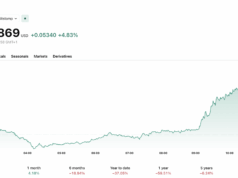

Cardano (ADA) added 14,783 new non-empty ADA wallets in the days following its June 23 price bottom, according to on-chain data firm Santiment. ADA has since gained +24% in seven days, touching $0.199 on July 5 before settling near $0.181, the first time the token has traded at these levels since 2020.
The wallet growth is the clearest on-chain signal yet that retail buyers stepped back in once prices stabilized. The harder question is whether June’s selloff was genuine capitulation, the kind of fear-flush that marks a durable floor, or simply a pause before the next leg down.
At the time of writing, ADA is trading at $0.181, down -4.5% over the past 24 hours, with a daily trading volume of $441.5M, suggesting a slight retrace that hasn’t been accompanied by a surge in volume. As long as $0.18 holds, Cardano will likely continue its recent bullish price action.
Cardano Surges as Retail Demand Shows Signs Of Strength
Cardano'a $ADA rose for four straight days with gains topping 30% over the last seven days. Most top 20 tokens saw weekly gains between just 1 and 18 percent.
Cardano also gained 14,783 new non empty wallets since July 23… pic.twitter.com/NkHgWKqzPq
— BSCN (@BSCNews) July 6, 2026
Cardano News: What the On-Chain Data Actually Shows
Santiment linked the wallet uptick to a broader mood shift inside the Cardano community, flagging it as a sentiment inflection point rather than just routine account creation.
The June 23 bottom also coincided with the launch of the Leios Musashi Dojo testnet, with Leios being the scalability upgrade Hoskinson has described as targeting a roughly 60× increase in throughput, positioning the network closer to XRP Ledger transaction speeds ahead of a planned mainnet push later in 2026.
Whale accumulation data adds a sharper edge to that picture. BeInCrypto reported that the 10M–100M ADA wallet cohort raised their share of circulating supply from 37.66% on June 25 to 38.13%, with large-output transactions spiking on June 21 and June 24.
The count of distinct large wallets hit a 45-day high – all while daily active addresses fell to a four-month low. That divergence is the classic smart-money signal: large holders accumulating into retail fatigue, positioning ahead of an expected catalyst.
Post-capitulation bounces tend to look exactly like this on-chain. Dormant wallets move large balances, transferring coins from weaker hands to stronger ones, before price recovers. Santiment’s Age Consumed metric recorded one of its largest spikes since April during this period, consistent with that redistribution pattern.
After months inside a descending channel, $ADA has finally broken out, reclaiming the 200 EMA while a textbook bullish RSI divergence signaled seller exhaustion before the move
Momentum has shifted back to the bulls, with the 200 EMA now acting as dynamic support. As long as ADA… pic.twitter.com/aOSGN4qIAm
— BATMAN
(@CryptosBatman) July 5, 2026
DISCOVER: Best Meme Coin ICOs to Invest in 2026
Governance Friction Keeps the Recovery Fragile
The ADA price recovery has not resolved the Cardano internal tensions. The sell-off had two drivers: a broad crypto market risk-off environment and Cardano-specific pressure stemming from failed treasury funding votes, a canceled 2026 summit, and founder Charles Hoskinson’s public warnings that more ecosystem projects could fail.
Hoskinson has since opened a governance-overhaul review, auditing thousands of decentralized DAOs tied to Cardano’s funding system. That review is still active, which means the next round of treasury votes carries real binary risk: a clean resolution strengthens the bull case, while another failed vote reopens the governance discount.
ADA sits roughly 87% below its cycle peak of $1.20 and still faces immediate resistance near $0.195 on the four-hour chart. The 14,783 new wallets and whale accumulation are constructive data points, but sustained recovery requires active addresses and transaction volumes to follow.
These metrics have not yet confirmed the move. The Leios roadmap and governance resolution are the two variables that matter most in the second half of 2026.
EXPLORE: Best Crypto Presales With Asymmetric Upside in the Current Market
The post Cardano Whales Accumulate as 14,783 New Wallets Join Post-Selloff appeared first on 99Bitcoins.