
A legal whitepaper published by strategic advisory firm Arden Consult has detailed the regulatory framework governing cryptocurrency exchange Binance’s planned return to the Philippines through its partnership with local fintech firm BlockShoals Technologies Inc. The document states that the operational model operates across two jurisdictions by separating digital asset trading from cash transactions to comply with local regulations.
According to the whitepaper, the framework divides compliance requirements between the Securities and Exchange Commission (SEC) and the Bangko Sentral ng Pilipinas (BSP). The structure handles cryptocurrency trading under SEC rules while routing Philippine peso transactions through an independent, licensed domestic partner.
The Split-Perimeter Model
As a background, unlike the European Union’s Markets in Crypto-Assets (MiCA) regulation, which bundles financial conduct and fiat conversion under a single regulatory umbrella, the Philippine legal landscape explicitly divides these powers between two separate agencies.
- The SEC Perimeter (Crypto Market Conduct): Under the SEC’s 2025 Crypto-Asset Service Provider (CASP) framework, the commission oversees the marketing, custody, and trading of digital assets. BlockShoals is registered within this perimeter as a Crypto-Asset Intermediary (CAI).
- The BSP Perimeter (Fiat Movement): The BSP regulates the conversion between the Philippine peso and virtual assets under Circular No. 1108.
Disputing the VASP License Omission:
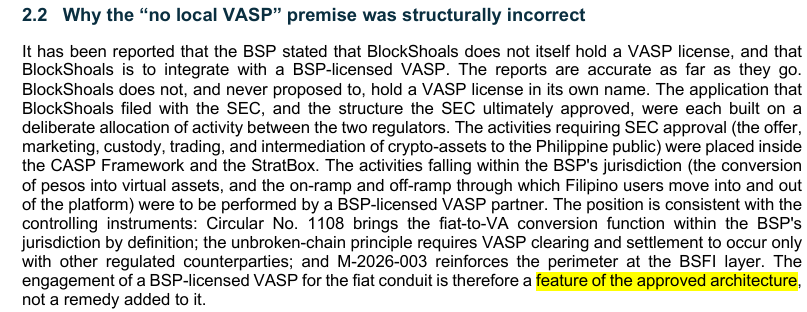
The whitepaper reveals that BlockShoals never proposed nor intended to hold an independent VASP license in its own name. Because the structure naturally isolates crypto-to-crypto activity on the SEC side, the architecture relies by design on an existing, fully licensed domestic VASP partner to manage the peso-denominated on-ramps and off-ramps. (Read more: List of Licensed Virtual Asset Service Providers in the Philippines)
As per Blockshoals:
The 90-Day ‘Pre-Phase’ Explained
The document provides context for the recent regulatory statements issued by both agencies:
According to the approved regulatory roadmap, this 90-day window is actually the “Pre-Phase” built directly into the SEC’s April 14, 2026 Notice to Proceed.
“The indicated 90-day period is intended solely for the establishment and integration of the technical infrastructure and systems between BlockShoals and its local VASP partner,” the SEC confirmed in a recent clarification.
The whitepaper added that this closed backend testing follows the SEC Strategic Sandbox framework, which mandates 15 risk-management conditions before public launch.
So How Will Binance and Blockshoals Work on BSP Compliance?
The report stated that the model addresses the BSP’s “unbroken chain” rule, which requires central bank-licensed platforms to only settle transactions with other regulated entities. To meet this requirement, the architecture incorporates an international regulatory anchor.
- The underlying trading engine operates under a license granted to Binance by the Abu Dhabi Global Market Financial Services Regulatory Authority in December 2025.
- Local cash transactions are routed through the licensed domestic partner directly to the regulated global platform.
As per the whitepaper, by routing retail peso conversions entirely through a BSP-licensed local partner that interfaces directly with an ADGM-regulated global platform, the transaction loop ensures that no leg of a Filipino user’s interaction touches an unvetted or unsupervised venue
Dual-Regulator Oversight Framework Now More Urgent Than Ever
Finally, the document highlights that closer structural harmony between the SEC and the BSP is already encoded into local rules. Specifically, BSP Memorandum No. M-2026-003, issued in January 2026, explicitly bars domestic retail consumers from directly accessing offshore platforms unless those venues are registered with either the BSP or the SEC.
This cross-recognition layer, the whitepaper stated, sets an important precedent: As the central bank introduces stricter asset-level boundaries (such as BSP Memorandum No. 23-2026, which bans domestic VASPs from listing privacy coins) the necessity for a coordinated, dual-regulator oversight framework becomes even more urgent.
Clarifications and Queries Submitted by BitPinas
BitPinas has formally sent clarificatory policy questions to both the Bangko Sentral ng Pilipinas (BSP) and the BlockShoals/Arden Consult corporate teams.
Listen to our latest episode
The core inquiries submitted to the BlockShoals target the remaining operational unknowns of the rollout:
- The identity of the VASP partner: Neither the SEC notices nor the whitepaper explicitly names the domestic VASP partner anchoring the crucial peso corridors. Until the partner is named, speculation will persist if the market cannot verify whether the gateway is a top-tier institutional player or an entity that could struggle under a rigorous Supervisory Assessment Framework (SAFr) review.
- BSP’s supervisory sign-off: The whitepaper frames the use of a local VASP as a natural, interlocking “feature of the approved architecture,” but only documents explicit approval from the SEC En Banc. BitPinas has requested clarity on whether the partner VASP has secured an explicit, formal notice of non-objection from the central bank to open its network pipelines to an offshore engine.
- AMLC Covered Person Status: Under the SEC’s Crypto-Asset Intermediary (CAI) sub-category, BlockShoals operates front-end user-data operations and local onboarding without directly holding assets. BitPinas has inquired whether BlockShoals maintains an independent registration with the Anti-Money Laundering Council (AMLC) or operates entirely under the partner VASP’s compliance umbrella.
- On market rumors regarding corporate ownership: There are strong persistent rumors circulating within the local tech ecosystem alleging political lobbying or equity connections involving figures associated with a former House Speaker in relation to the platform’s reentry strategy. BitPinas has requested an official statement to clarify or deny these rumored ties on the record.
This article is published on BitPinas: Inside Binance PH Comeback Plan: Whitepaper Outlines SEC-BSP Structure Behind BlockShoals Partnership
What else is happening in Crypto Philippines and beyond?